Having trouble viewing this email? Read it on the web.
| Cars are delivered on a production line at SAIC General Motors Dongyue Automobile Co. Ltd. in Yantai, Shandong province, China, November 17, 2022. © 2022 CFOTO/Future Publishing via Getty Images |
|
|
|
Carmakers’ Blind Spots on Forced Labor in ChinaDo you have a car? If so, there’s a good chance it has parts made with forced labor in China. A new HRW report details how global carmakers, including General Motors, Tesla, BYD, Toyota, and Volkswagen, are failing to minimize the risk of Uyghur forced labor being used in their aluminum supply chains. In researching this report, HRW investigators scoured tens of thousands of pages of open-source, online materials, such as company reports, government statements, and social media posts. In doing so, they were able to link carmakers’ aluminum supply chains to forced labor. Forced labor in the aluminum industry centers on government-backed “labor transfer” programs, which, under the guise of “poverty alleviation,” coerce Uyghurs and other Turkic Muslims into jobs in Xinjiang and other regions, often far from home, where they work grueling hours and are subjected to mandatory political indoctrination. |
| WATCH: Carmakers Implicated in Uyghur Forced Labor |
|
|
|
Consumers should know their cars might contain materials linked to forced labor or other abuses in Xinjiang, a region in China where the government is committing multiple crimes against humanity. The problem is, car companies simply don’t know the extent of their links to forced labor in their aluminum supply chains. Ten percent of the world’s aluminum supply comes from Xinjiang, but by the time it reaches a car manufacturing plant, it might have been mixed and diluted with other materials, making it difficult to trace. But international industry giants have a responsibility to know this. Most carmakers have done too little to map their aluminum supply chains and identify links to forced labor. And because of the size of China’s own car market and the need to compete, many have succumbed to Chinese government pressure to apply weaker human rights and responsible sourcing standards in their China-based operations. The bottom line is that, if competition is driving business in the auto industry, it doesn’t have to be a race to the bottom. Governments and consumers shouldn’t have to tolerate cars containing materials or parts made with forced labor. Read More |
| Portraits of hostages from Israel held in Gaza since the October 7 attacks in Tel Aviv, December 17, 2023. © 2023 Menahem Kahana/AFP via Getty Images |
|
|
|
Building Evidence for October 7 Crimes in IsraelBelkis Wille, associate director in the Crisis and Conflict Division at Human Rights Watch, spent three weeks in Israel following the Hamas-led October 7, 2023 attacks on more than 20 communities and a music festival near the Gaza Strip, as well as nearby military bases. In a new interview, she talks to Birgit Schwarz, communications deputy director for Europe and Africa at HRW, about what her team has uncovered so far about the attacks, what it takes to build sufficient evidence when investigating serious international crimes, and why meticulous, independent research is crucial in the struggle for impartial justice. Read More |
| Last week, it was reported that 10.7 million people have been uprooted from their homes in Sudan, including 9 million displaced internally—two-thirds since the conflict broke out in April 2023. This grim record should be a wake-up call. Read More |
|
| The junta’s widespread and systematic abuses against the population – including arbitrary arrests, torture, extrajudicial killings, and indiscriminate attacks on civilians – amount to crimes against humanity and war crimes. Read More |
|
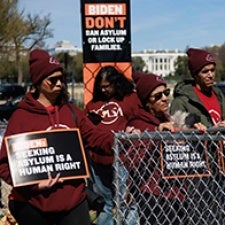
| Given all the political grandstanding on border issues ahead of the 2024 US elections, it’s best not to lose sight of the principles at stake. Read More |
|
| People attend a rally to defend the right of abortion in Paris, France, September 26, 2020. © 2020 Pierrick Villette/Avenir Pictures/Abaca/Sipa via AP Images |
|
|
|
In this new section, we’ll be highlighting positive human rights stories. Here’s what we’re looking at this week. Good News on Reproductive Rights in France This week, France got one step closer to enshrining the freedom to abortion in its constitution. If passed, the bill, which now must be voted on by the Senate and Congress, would make France the first country in the world to constitutionalize abortion rights. Liberian President Commits to Creating War Crimes Court
Liberia’s president recently announced that he will ask for the UN Secretary General’s help in creating a war crimes court. The announcement follows years of work by HRW, along with Liberian civil society partners and other international rights organizations, to advance justice for grave crimes committed during Liberia’s back-to-back civil wars. |
Want to test your human rights knowledge? Take our quiz and see how you stack up. Find It Here |






Geen opmerkingen:
Een reactie posten