Having trouble viewing this email? Read it on the web.
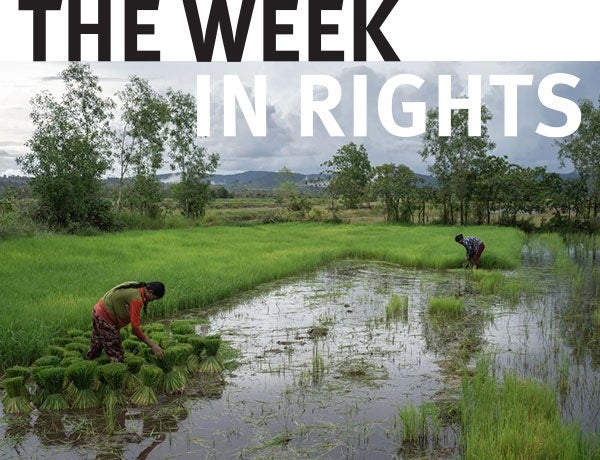
| Community members harvest rice in one of the villages included in the Southern Cardamom REDD+ Project in Koh Kong province, Cambodia, June 25, 2022. © 2022 Human Rights Watch |
|
|
|
Cambodia’s Carbon Project Violates Indigenous RightsA major environmental conservation project that encompasses a rainforest in Cambodia is plowing ahead, but the Indigenous peoples living there now face eviction and criminal charges for farming and foraging on their traditional lands. In a new 118-page report, Human Rights Watch details the REDD+ “carbon offsetting” project and the harm it has done to local Indigenous communities. In fact, for two years after the project began, no one involved the community in key decisions or agreements concerning their rights to the land and forests. The project is being carried out by the Cambodian Ministry of Environment and the conservation group Wildlife Alliance. The initiative encompasses half a million hectares and 29 villages that include 16,000 people in Cambodia’s Cardamom mountains, a rainforest area that has been home to the indigenous Chong people for centuries. The Chong agree with the project’s aim of protecting the rainforest, but they want to be treated as partners. What is Carbon Offsetting? As pressure to cut emissions rises, companies and governments are turning to carbon offsetting, where they buy carbon credits to compensate for a share of their pollution, delaying their own decarbonization. The video below explains how this works. |
Human Rights Watch spent two years investigating what is happening in the area, interviewing more than 90 people in 23 villages included in the project, as well as government officials. Our researchers also analyzed satellite imagery, topographic maps, media reports, and social media. Since September 2022, HRW has met and communicated with Cambodia’s Environment Ministry, Wildlife Alliance, and other key private actors involved in the project. Casualties of Conservation The project has incorporated eight Chong villages into a protected national park. But as these agreements between Wildlife Alliance and the Cambodian government were drawn up, they failed to acknowledge the Chong peoples’ customary use of this land or their ownership of the carbon stored on it. Community members told us they were arrested and mistreated after collecting forest products in the conservation area – a sustainable activity that they have always engaged in. Six Chong families also described being forcibly evicted by the rangers, gendarmes, and Wildlife Alliance staff from land they had customarily farmed. “They [Wildlife Alliance] have no concern with our Indigenous identity,” said a resident of one Chong commune we spoke to. “They’ve never asked us for permission because from their perspective they already have an agreement with the government.” A Global Lesson As noted by Luciana Téllez Chávez, senior environment researcher at HRW, “Conservation strategies that sideline and punish Indigenous peoples to address the global environmental crisis are unacceptable and counterproductive.” Read More |
| This week, a Russian court, in a clearly farcical trial, sentenced one of the country’s top human rights leaders, Oleg Orlov, to 2 years and 6 months in prison on charges of “discrediting” Russia’s armed forces. Read More |
|
| “Disappearing” civil society activists and political opponents appears to be part of the military junta’s crackdown on peaceful dissent. And it is happening more frequently. Read More |
|
| Hundreds of Tibetan monks and villagers were peacefully protesting the construction of a new hydroelectric dam that will generate electricity for eastern China, but it will also submerge historic monasteries and numerous Tibetan villages. Read More |
|
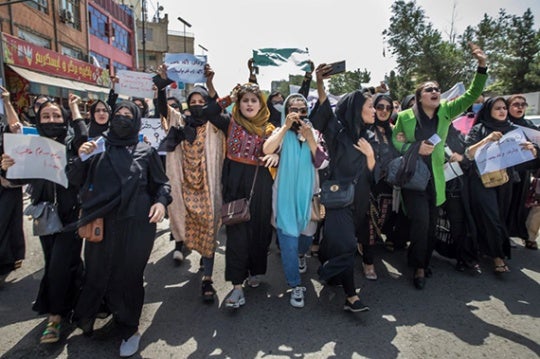
| : Afghan women demonstrate in the center of Kabul, Afghanistan, August 13, 2022. © 2022 Oriane Zerah/Abaca/Sipa USA via AP Photo |
|
|
|
In this section, we aim to highlight positive human rights stories. Here’s what we’re looking at this week. A Rare Victory in Afghanistan Afghanistan’s Taliban government recently announced that women and girls who have graduated from 12th grade can begin enrolling in state-run medical institutes in 11 provinces in the country. Human Rights Watch released a report in February detailing how the Taliban’s bans on education for women and girls has contributed to Afghanistan’s healthcare crisis. This new directive is a step in the right direction. |
Want to test your human rights knowledge? Take our quiz and see how you stack up. Find It Here |
Get breaking human rights news delivered to your Inbox Monday through Thursday with HRW's Daily Brief newsletter. Sign up here |







Geen opmerkingen:
Een reactie posten