


Good morning,
EU states have their embassies in Brussels, where national officials grind away on often complex bills at the EU Council. Also known as permanent representations, the faceless co-legislators are not always the most transparent when it comes to figuring out who is who.
Even the most elementary task of getting the name of someone specialised in a particular policy area can be a daunting exercise. A new report by Civil Society Europe, a Brussels-based consortium of European networks of civil society organisations, has attempted to shed some light.
They looked for organigrammes, staff names and portfolios, as well as contact details, and meetings with lobbyists.
All this information could be found at permanent representations from Croatia, Finland, Italy, Portugal, Romania and Sweden. The six are seen as the most transparent, while Bulgaria and Ireland are the least.
Somewhere in the middle are the Czech Republic, France, Hungary, Malta, Poland, Slovakia, Slovenia, and Spain. Others like Cyprus, Estonia, Latvia, Lithuania, Luxembourg only publish contact details of their staff but over zero input on lobbying.
Civil Society Europe had carried out a similar study in 2023. The Czech Republic, Denmark and Spain have since fallen in transparency standards.
The backsliding and disparate mix of standards among the representations is part of a wider transparency problem when it comes to legislative making at the EU level.
There have been some improvements over the years, but the obfuscation and complexity are a democratic accountability loss, especially for the electorate. Instead, those in the know tend to be the lobbyists, whose interests are not always aligned with the public good.
- Nikolaj Nielsen, home affairs editor
Advert
If you (or your organisation) is interested in getting access to a unique view on EU affairs, there's more information about institutional memberships here. Share it with your boss and relentlessly pester them to get one. Or share the right contact person with at@euobserver.com.
Story of the Day
Apple and Meta face first-ever EU tech-rule fines
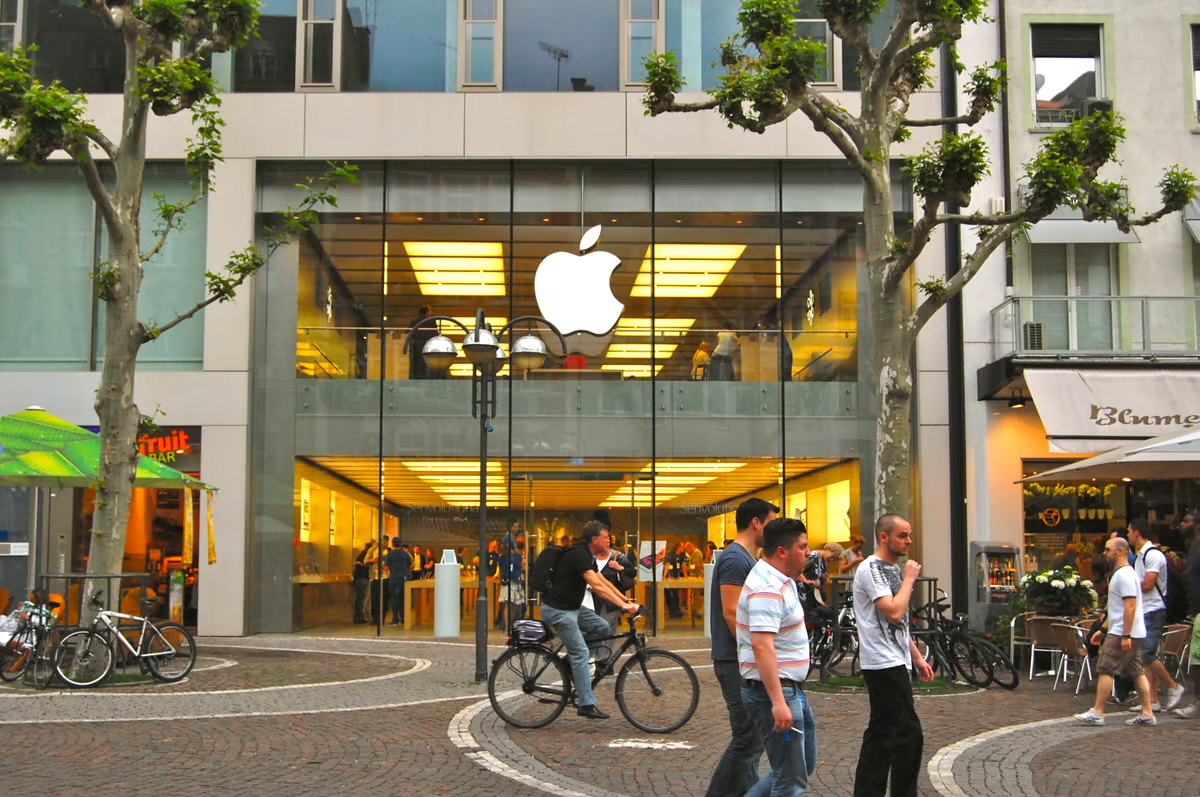
The European Commission has handed down its first enforcement actions under the Digital Markets Act (DMA), going after Apple and Meta for failing to meet their gatekeeper duties. The EU fined Apple €500m and Meta €200m, giving both 60 days to comply or face daily penalties.
What else you need to know
EU states weaken anti-corruption bill, key MEPs say
European lawmakers are complaining that member states are watering down an anti-corruption bill amid questions on whether to include EU institutions as part of its scope. Read on »
Cyprus and Greece wary of Syria sanctions relief
The EU is slow-walking its Syria sanctions relief due to Cypriot-led fear of violent Islamism and Turkish power. Read on »
Slovakia’s crackdown on NGOs echoes Putin’s playbookOpinion
Russia’s infamous foreign agent law has prompted a wave of imitators in Eastern Europe – most recently in Slovakia. Read on »
Advert
How Trump both fuels and dims Europe’s anti-migration populismOpinion
The chaos and contradictions of US president Donald Trump’s leadership have made many European voters wary of embracing similar figures. Probably contrary to his intentions, it seems that Trump, rather than a boost, might be a big blow to some of the far-right populist parties, which usually campaign on anti-migration agendas. Read on »
Apple and Meta face first-ever EU tech-rule fines
EU fines Apple €500m and Meta €200m for breaking digital rules, giving both 60 days to comply or face daily penalties.Read on »
Europe's health at a crossroads: Stronger efforts needed to achieve 2030 targetsStakeholders
While progress has been made in reducing new HIV and tuberculosis infections, the current pace is insufficient to meet the 2030 SDG 3 targets for HIV, TB, viral hepatitis, and STIs.Read on »
In case you missed it
Trailing in the polls, who will Orban's scapegoat be at 2026 election?Opinion
For Viktor Orbán, Péter Magyar poses a new and troubling problem. Unlike previous opponents, who have been targeted on the basis of their political background, or association to critical institutions, Magyar is one of the Fidesz family.Read on »
Why we're suing Elon Musk's X for German election dataOpinion
As part of our research agenda, we gained access to TikTok’s Virtual Compute Environment (a secure data room designed for civil society organisations in lieu of its API) and Meta’s Content Library. X, however, was not cooperative.Read on »
Only 1.3% of EU data privacy cases result in fines, research shows
Despite — or because of — being a major hub for tech companies in Europe (including Apple, Google, Meta, and Microsoft, making Irish authorities in charge of some of the largest cases of data protection in Europe), Ireland sanctioned only 0.26 percent of the cases.Read on »

Geen opmerkingen:
Een reactie posten