


Good morning,
It’s been remarkable to watch how much energy Brussels is spending to dismantle its own Green Deal.
It seems not that long ago that it inspired Frans Timmermans to channel John F. Kennedy’s ‘man on the moon’ speech which was, I don’t know, sort of inspiring?
But those days are definitely gone. Since February, the commission has launched four so-called omnibus packages, each aimed at simplifying EU law.
In practice, they’ve become a vehicle for environmental deregulation, from farming and industrial emissions to finance. Some of the pieces of legislation form the heart of the EU's Green Deal.
We have focused on the commission’s efforts to roll back corporate transparency and accountability rules (CSRD) and due diligence legislation (CSDDD). Rules meant to prevent harm to people and the planet across corporate supply chains. But they’re new and complex, and ever since Draghi called them “burdensome” in his competitiveness report, the commission has moved heaven and earth to roll them back.
Today, ambassadors from EU countries meet to “receive guidance” on how far to go in weakening the rules. In parliament a true shitstorm is brewing ahead of a vote in July, with the economy and environment committees filing over 1,000 amendments in the past week, many of them miles apart.
A potential final deal in October, resembling the current council and commission positions, would mean that the scope of green reporting would only apply to companies with more than 1,000 employees (rather than 250), in effect reducing the scope of the legislation by 80 percent (but that's not all).
That’s a lot of political energy spent dismantling rules no one’s even really tried yet.
Maybe for this reason, it's been difficult to find people who are happy with the way the omnibus has been rolled out.
Off the record, sources described the omnibus process to EUobserver as “completely deranged” — a “bonkers proposal that doesn’t address the actual problems at all,” pushed through with no space for analysis. “This isn’t about good policy anymore,” another source said. “It’s pure power-hungry politics.”
Sure, Europe’s biggest party, the EPP, seems happy. It chairs the legal affairs committee, which oversees the parliament’s position, and controls the key rapporteurs in both the environment and economy committees.
Ursula von der Leyen, Poland's council presidency, and the largest member states are all dominated by EPP politicians or their liberal and far-right fellow travellers, are all critical of existing green rules.
But last week, more than 100 economists warned against gutting the CSRD and CSDDD, and polling suggests firms like the omnibus a lot less than existing sustainability rules.
Professor Scott Marcus, who was invited by the parliament's legal committee to share findings of the commission's omnibus proposal last week, told MEPs that the process was "so flawed that it’s hard to even assess the substance properly."
He also deplored the commission’s decision to rush through the simplification efforts without doing a cost-benefit analysis.
While much attention has been put on how “burdensome” green reporting rules are, the benefits "have been completely ignored,” he said.
And it's hard to measure the burden of costs anyway. Since most companies have barely used CSRD and have no experience at all with CSDDD, estimating costs now is “like tapping in the dark,” one expert told EUobserver.
– Wester van Gaal, green economy journalist
This year, we turn 25 and are looking for 2,500 new supporting members to take their stake in EU democracy. A functioning EU relies on a well-informed public – you.
Advert

Top story
'Qualified majority' of EU states seek anti-Orbán pushback
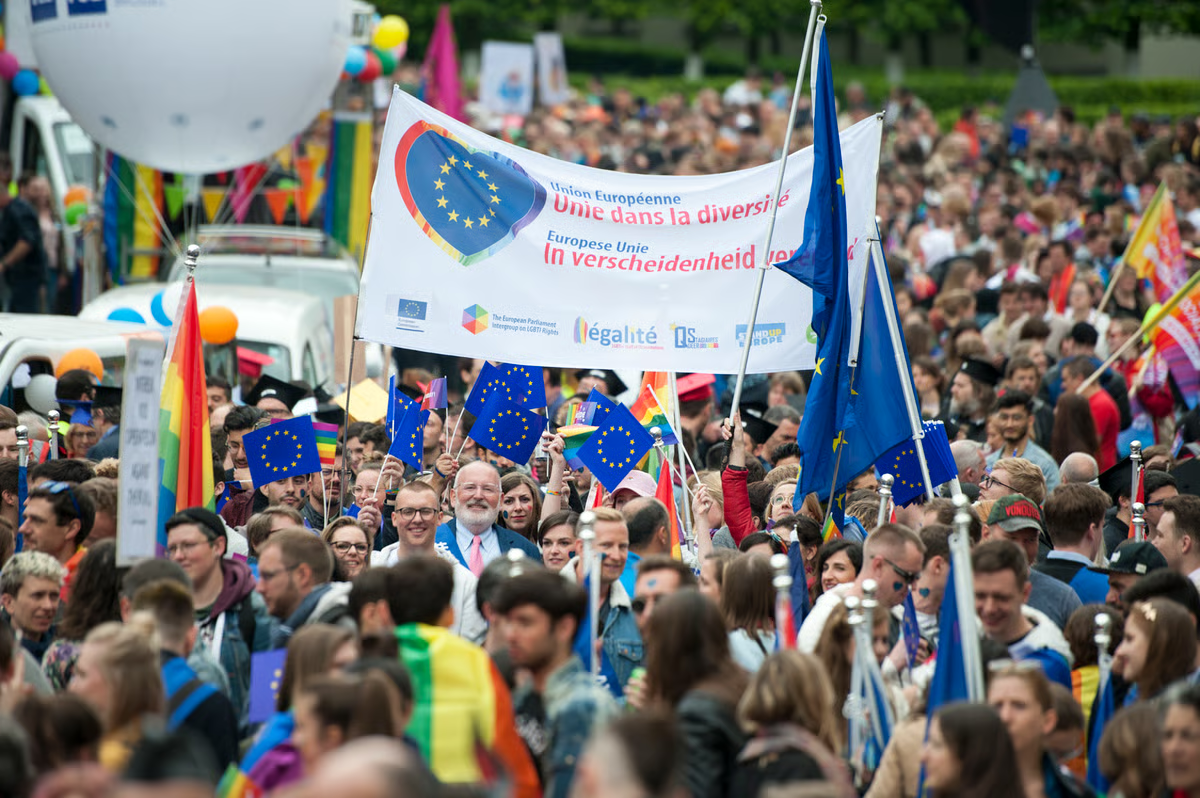
Homophobia as well as Russophilia could cost populist Hungarian prime minister Viktor Orbán his EU veto, 20 other EU countries warned on Tuesday.
What else you need to know
Carlos Lopes — Europe’s insecurity and delusion about Africa
Cape Verde economist and former African Union advisor Carlos Lopes has seen the so-called “partnership of equals” touted by Brussels flounder on a desire to open up market access for European countries, rather than help Africa industrialise.Read on »
'Qualified majority' of EU states sign anti-Orbán pushback
Homophobia as well as Russophilia could cost populist Hungarian prime minister Viktor Orbán his EU veto, 20 other EU countries warned on Tuesday. Read on »
Advert
Decoupling and fastracking Moldova's EU accession ahead of Ukraine could workOpinion
Marta Kos, the EU commissioner for enlargement, recently stated she would not rule out “decoupling” Moldova’s accession process from that of Ukraine. While the suggestion has been met with criticism from Kyiv, fast-tracking Moldova into the EU might not be such a bad idea strategically, writes Hugo Blewett-Mundy.Read on »
What TikTok algorithm reveals about weakness of centre-right brandColumn
It seems that the TikTok recommender AI had a clear conception of the centre-left universe and a clear conception of the far-right universe — but it became very uncertain about what the centre-to-right may be, writes Michael Meyer-Resende.Read on »
Military power ‘precondition’ for euro’s global rise, Lagarde says
Boosting the euro’s global role will require Europe to commit boosting its hard power, ECB president Christine Lagarde told an event in Berlin. Read on »
In case you missed it
Why concessions to Orbán will come back to bite EUAnalysis
As the EU hopes to agree on further financial aid for Ukraine, fears are emerging over offering concessions to Hungary, which risk setting a dangerous precedent and the threats of legal challenges.Read on »
How Article 7 could actually defeat Orbán already
The unanimity criteria should not discourage member states from seeking the deployment of Article 7 against Hungarian prime minister Viktor Orbán. If exercised wisely and strategically, peer pressure may bear fruit.Read on »
Drainpipe of shame: How Orbán hypocrisy became a gay icon in BrusselsFeature
The drainpipe in Brussels where a far-right MEP fled a gay orgy still attracts tourists, who take pics to remember what Hungarian prime minister Viktor Orbán really represents. Read on »

Geen opmerkingen:
Een reactie posten