


Good morning,
If your heart broke a little on 4 December, when the US published a far-right security manifesto, then you might find therapeutic its defence strategy of 23 January.
The [/wp-content/uploads/2025/12/2025-National-Security-Strategy.pdf]national security screed was written by US president Donald Trump's White House.
It fantasised about "civilisational erasure" of Europe by Muslim migrants, pledged to back anti-EU parties, was welcomed by the Kremlin, and came amid mounting tension over Trump's threat to seize Greenland by force, which would have ended Nato.
The new defence strategy was published by the Pentagon, spoke of Europe as an "ally" at every turn, made sad reading for Russia, and came after Trump backed down on Greenland, causing a collective sigh of relief at last week's EU summit.
Looking at conventional warfare, the defence paper said: "Russia will remain a persistent but manageable threat to Nato's eastern members for the foreseeable future", had "deep reservoirs of military and industrial power", and the "national resolve required to sustain a protracted war in its near abroad".
But "Moscow is in no position to make a bid for European hegemony. European Nato dwarfs Russia", the US added.
"Our Nato allies are substantially more powerful than Russia - it is not even close," it said.
And on top of this, the US "will also continue to play a vital role in Nato ... we are and will remain engaged in Europe," the US said, although it repeated its long-standing view that China was the main threat to global US interests.
China was "the most powerful state relative to us since the 19th century", it said.
It's hard to say if the change in tone on Europe is because the anti-EU strategy came out of the White House, while the defence paper came out of the Pentagon, or because Trump changed his mind between 4 December and 23 January.
But on a personal note, I recently interviewed Italian (retired) admiral Luigi Binelli Mantelli, who was Italy's armed forces chief until 2015, and who voiced "faith" that US military commanders still felt fraternal Atlanticist ties, just like the now also retired US admirals and generals of his generation, such as James G. Stavridis and Martin Dempsey.
"I find it hard to imagine any US military leadership totally different from these people, and I am sure that it is not so; I have faith in the US military system," Binelli Mantelli told me, despite Trump's flip-flopping on the EU, Nato, and Russia.
Edgar Buckley, a British former Nato assistant secretary general for defence planning, felt the same.
"I imagine that Trump has not greatly affected mutual respect at the military level," Buckley said by email on Sunday evening, helping me sleep better.
"I imagine the world has now moved on from these issues [Trump's Greenland threat]," he added.
But "I still cannot foresee possible military confrontation between allies," Buckley said, no matter what the White House might think of next.
- Andrew Rettman, foreign-affairs editor
Advert
EUobserver relies on subscriptions to hold the EU to account – if you're not already, do consider becoming a supporting member here.
Agenda
THIS WEEK: US-EU trade, migration, and Amazon hearings
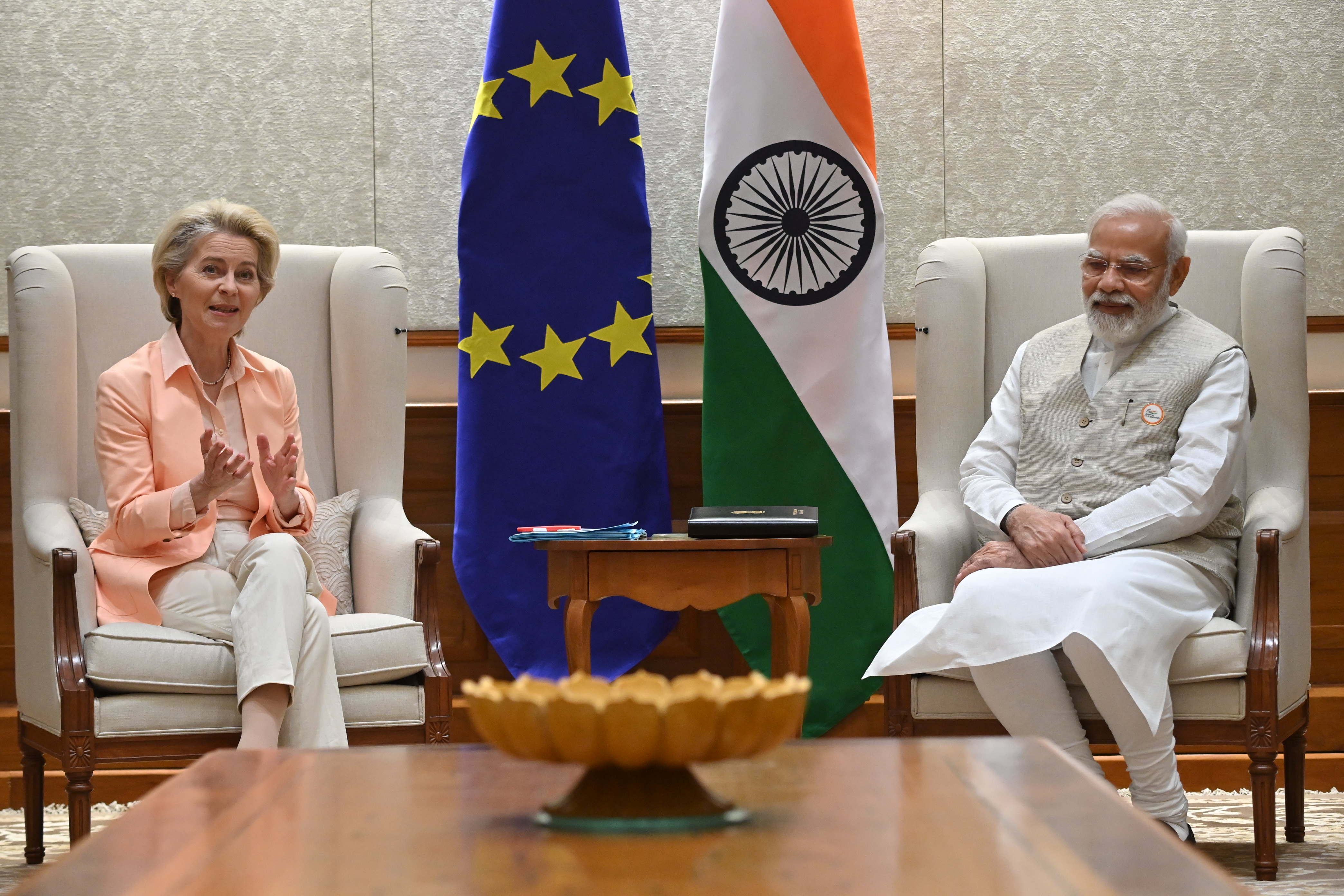
EU Council president António Costa and commission president Ursula von der Leyen are visiting India this week to finalise a trade agreement, while MEPs in Brussels will discuss the EU-US trade deal and the next long-term EU budget.
What else you need to know
THIS WEEK: India trade deal, US-EU relations and Amazon hearing
EU Council president António Costa and commission president Ursula von der Leyen are visiting India this week to finalise a trade agreement while MEPs in Brussels will discuss the EU-US trade deal and the next long-term EU budget.Read on »
EU blacklist names Iranians behind January massacre of protestors
EU foreign ministers are to blacklist 14 Iranians for killing peaceful protesters, as the US renews its threat of military strikes. Read on »
Plummeting EU development aid risks being compounded by a lack of ambitionAnalysis
The EU Commission wants to create new partnerships with the private sector to plug the gaps left by falling aid budgets. But it still lacks imagination.Read on »
Chief liberal MEP negotiator edging towards far-right in deportation clash
Ongoing disputes over a series of deportation amendments in the European Parliament suggest that the liberal MEP steering the negotiations is edging closer to the far-right.Read on »
Advert
EU to clinch 'mother of all trade deals' with India
EU leaders are set to sign trade and defence agreements with India next Tuesday during a three-day summit — closing what European Commission president Ursula von der Leyen has described as the “mother of all trade deals”.Read on »
UN chemical expert: 'There's pressure on EU from US to weaken regulatory controls'Interview
Chemical pollution remains one of the world’s most under-recognised crises. Dr Marcos A. Orellana, UN special rapporteur on toxics and human rights since 2020, talks to EUobserver about the wide gap between the science and the political will, the hidden risks of hazardous chemicals.Read on »
With Gaza in rubble, why the EU push to 'fix' Palestinian Authority is doomed to failOpinion
The EU and the West's premise is simple and comforting: Hamas must go, Israel will not rule Gaza, and therefore a reformed Palestinian Authority must step in. But this consensus rests on a political fiction, writes Khalil Shikaki, director of the Palestinian Center for Policy and Survey Research in Ramallah.Read on »
Listen: Could the EU court of justice kill the EU-Mercosur trade agreement?Podcast
What exactly did European Parliament vote for around the EU–Mercosur trade deal, what could the judges decide, and how much power does this really give lawmakers over one of the EU’s biggest trade agreements?Read on »
In case you missed it
EU auditors push back at rightwing weaponising of NGO audit
The European Court of Auditors twice told rightwing and far-right MEPs that its report was not about NGO transparency, but about whether the European Commission ensures transparency in allocating EU funds to non-governmental organisations.Read on »
The rise of necropolitical oligarchy — a global challengeColumn
The exhibitionist display of raw power is no longer Russia’s alone. As the United States drifts toward “might is right” governance, a necropolitical oligarchy takes hold — one that only a politically unified Europe might counter, argues Anton Shekhovtsov. Read on »
Sense of relief, as EU leaders' summit reaffirms transatlantic relations
EU leaders spoke of unity and relief ahead of their informal meeting on Thursday, praising the bloc's strength against intense US tensions, while also relieved that president Trump rescinded his tariff threat. Read on »
Nato plans new Arctic mission, 'faith' remains in transatlantic ties
Nato is to draw up plans for a new Arctic security mission by July, as one former Italian admiral voices "faith" in US military ties despite the Greenland crisis. Read on »
EU open to Trump’s ‘Board of Peace’ if it stays within UN lines
Bulgaria and Hungary have joined Donald Trump's Board of Peace as EU member states remain perplexed by a concept that challenges the United Nations.Read on »
Trump's Gaza Peace Board — and the EU is missing in inaction againOpinion
The EU, instead of contending itself with the undignified role of a subservient payer and sidekick of US interests, must prioritise a robust and ambitious diplomatic strategy towards Israel, moving from mere statements of discontent to actionable efforts that hold the Israeli government accountable for its blatant violations of international law, writes former EU ambassador Sven Kühn von Burgsdorff..Read on »

Geen opmerkingen:
Een reactie posten