


Good morning,
EU leaders have agreed to fund Ukraine through joint borrowing rather than immediately using Russian frozen assets, a win for Belgian prime minister Bart De Wever, who had long opposed a reparations-style loan over fears of Russian retaliation.
After more than 15 hours of talks, leaders settled on a “bridge financing mechanism”, using EU debt to provide a €90bn loan to cover Ukraine’s immediate needs.
"Ukraine has won; Europe has won; financial stability has definitely won [and] International law has also won today,” he said, arguing that rationality had prevailed and legal chaos was avoided.
“I’m proud that we have been able to contribute to this outcome,” he added. “This is not a fragile product. It is a stable, legally robust and financially credible European solution. These are charted waters we are traversing.
Work will continue on a separate plan to tap into the estimated €210bn in frozen Russian assets held across Europe, mainly at Brussels-based Euroclear.
The Czech Republic, Hungary, and Slovakia are exempt from any financial obligations.
Attempts to finalise a reparations loan based on Russian assets continued late into the night. For now, tweaking the EU’s budget to free up collateral for borrowing proved the easiest way forward, helping bring all 27 member states on board.
Germany had pushed for a frozen-assets plan ahead of the summit but ultimately agreed to the joint-borrowing scheme.
“This sends a clear signal to Putin: this war will not be worth it. We will keep Russian assets frozen until Russia has compensated Ukraine,” German chancellor Friedrich Merz said.
- Wester van Gaal - Economy editor
Advert
EUobserver relies on memberships to hold the EU to account – if you're not already, do consider becoming a supporting member here.
Top Story
EU opts for joint borrowing after marathon talks on Russian frozen assets fail
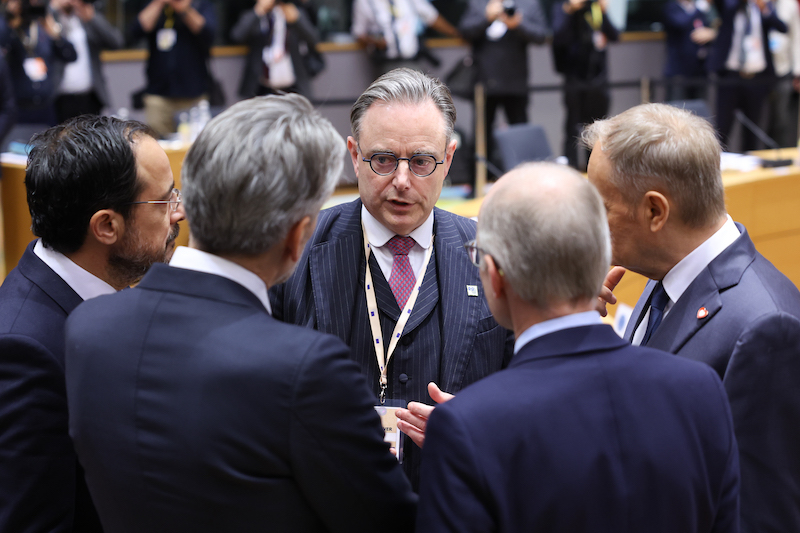
EU leaders decided to use joint borrowing instead of Russian frozen assets to support Ukraine, in a big win for Belgian prime minister Bart De Wever, who had long opposed the idea of a reparations loan amid fears of retaliation from Russia.
What else you need to know
EU opts for joint borrowing after marathon talks on Russian frozen assets fail
EU leaders decided to use joint borrowing instead of Russian frozen assets to support Ukraine, in a big win for Belgian prime minister Bart De Wever, who had long opposed the idea of a reparations loan amid fears of retaliation from Russia. Read on »
Farmers protest highlights EU division on Mercosur as trade deal faces crunch
A major dispute over the fate of a trade deal with the South American Mercosur bloc was dominating an EU leaders’ summit in Brussels on Thursday and Friday, after thousands of farmers protested outside the EU institutions. Read on »
Zelensky to Belgium: ‘we are at war, and I think that we face bigger risks’
Ukrainian president Volodymyr Zelensky reiterated to EU leaders that there are bigger risks than lawsuits if Europe doesn't act against Russia by using its frozen assets, at the at the December European Council summit. Read on »
'I'm not giving up': Belgian PM sticks to conditions on Russian assets ahead of EU summit
Belgium is threatening to block an EU plan to fund Ukraine with frozen Russian assets, as prime minister Bart de Wever draws a red line over risks to Euroclear and national financial security ahead of a decisive European summit. "I'm not giving up,” he said.Read on »
Advert
Why the EU should pay attention to Putin’s Kyrgyzstan visitOpinion
The size and composition of Vladimir Putin's delegation, including Roman Abramovich and the head of the Central Bank, and their red-carpet reception in Bishkek shows accelerating rapprochement between Bishkek and Moscow — and casts ominous doubt over future respect for human rights in what was once Central Asia’s most promising democracy.Read on »
Momentum builds at EU summit to roll back asylum protections
Pressure continues to mount to curtail asylum arrivals, as over a dozen EU states are hoping to maintain a momentum to limit rights.Read on »
EU top court kills off claim by over 400 ex-MEPs to replenish luxury pension fund
The EU’s top court has thrown out a claim filed by more than 400 former MEPs against a decision to halve the payments from their controversial voluntary pension scheme — that would landed the European taxpayer with a bill of more than €200m. Read on »
The generative AI 'transformation' will only work if workers trust itStakeholder
“When employers and unions sit at the table early – before systems are rolled out – we avoid problems later", Oliver Roethig, a trade union leader at UNI Europa, the European federation of unions in private services, explains.Read on »
In case you missed it
Spain, Ireland, Belgium, Luxembourg urge more EU action on Gaza ceasefire
Foreign ministers from Spain, Ireland, Belgium, and Luxembourg have jointly urged the EU to use its “considerable leverage” with Israel to address what they describe as still a humanitarian catastrophe in Gaza, despite ceasefire efforts.Read on »
EU Commission scraps 2035 combustion engine ban in major win for car lobby
The European Commission has overturned a planned ban on European car manufacturers producing petrol-driven vehicles after 2035, in a major win for the EU’s industry lobby on Tuesday. "Clinging to combustion engines won't make European automakers great again,” warned one environmental group.Read on »
Euro dreams or mafia schemes? Inside Bulgaria’s deeper crisisFeature
The collapse of the Bulgarian government last week following massive anti-graft protests puts in sharp relief a state captured by deep corruption that has for years served the interests of a ruling elite. Read on »
The EU's new asylum 'safe countries' list is a fantasy wonderlandOpinion
Contrary to the name, the EU's safe country of origin list is not primarily based on safety considerations. In fact, the EU’s new asylum legislation on ‘safe country policies’ forms part of a system whose aim is to reject and deport more quickly. Read on »
Bolshoi-loving banker threatened Euroclear CEO, amid EU talks on Russian assetsInvestigation
A French banker inside Euroclear, who flew to Russia 155 times for "private" reasons, allegedly tried to connect the company's CEO, Valérie Urbain, with Russian spies and threatened her when she declined, according to an investigation by EUobserver, Humo, De Morgen, and Dossier Center.Read on »

Geen opmerkingen:
Een reactie posten