Marriage Equality Ballots Succeed in Three States
(New York) – The successful ballot initiatives on same-sex marriage in Maine, Maryland, and Washington State on November 6, 2012, were major victories for gay rights both in the United States and globally.
Voters arrive to cast their votes during the U.S. presidential election at a polling station in Washington on November 6, 2012.
© 2012 Reuters
The three state referendums endorsing marriage equality are groundbreaking because nowhere else in the world has same-sex marriage been won by a popular vote. All other marriage-equality measures in the US and elsewhere have been made by legislators or courts.
Boris Dittrich, advocacy director of the Lesbian, Gay, Bisexual, and Transgender Rights Program
“The three state referendums endorsing marriage equality are groundbreaking because nowhere else in the world has same-sex marriage been won by a popular vote,” said Boris Dittrich, advocacy director of the Lesbian, Gay, Bisexual, and Transgender Rights Program at Human Rights Watch. “All other marriage-equality measures in the US and elsewhere have been made by legislators or courts.”
In Maryland, voters upheld a law legalizing same-sex marriage that was passed by the legislature and signed by the governor. This means that, most likely beginning January 1, 2013, same-sex couples will be able to get married in the state.
In Washington State, the legislature had approved same-sex marriage, but opponents gathered enough signatures to force a referendum in an effort to ban it. The referendum vote means that civil marriage will be opened for same-sex couples.
In Maine, gay rights activists had lost a vote on same-sex marriage in 2009, but put the issue on the ballot again. This year they were successful.
Additionally, voters in Minnesota turned back an effort to restrict gay rights. They rejected a proposed marriage equality ban by voting “no” in a referendum seeking to amend the state constitution to restrict marriage to a man and a woman.
The election results in Maine, Washington, and Maryland reversed a trend, Human Rights Watch said. Previously, whenever same-sex marriage had been put before voters in US states, it had lost. In 30 states voters have limited marriage to a man and a woman through constitutional amendments, and same-sex marriage had also been blocked in referendums, as it was in California in 2008.
Same-sex marriage will now be legal in nine US states. The others are Connecticut, Iowa, Massachusetts, New Hampshire, New York, and Vermont, as well as Washington, DC. However, under the Defense of Marriage Act, the US government denies recognition of same-sex marriages and federal benefits that are conferred upon married couples.
Outside the US, same-sex marriage is legal in Argentina, Belgium, Canada, Denmark, Iceland, the Netherlands, Norway, Portugal, South Africa, Spain, Sweden, and Mexico (where same-sex marriages are allowed in the capital city, but are recognized nationwide). In Spain the Constitution Court decided on November 6, 2012, that the same-sex marriage bill, implemented in 2005, is constitutional. In Brazil, the Superior Justice Court set an important precedent in October 2011 by interpreting the Brazilian civil code as allowing same-sex marriages.
Marriage equality laws are expected to be adopted soon in France, the United Kingdom, and New Zealand.
“Marriage equality is unstoppable,” Dittrich said. “The votes in these US states should galvanize initiatives around the world.”
Bron : Human Rights Watch
SPREAD THE INFORMATION
Any information or special reports about various countries may be published with photos/videos on the world blog with bold legit source. All languages are welcome. Mail to lucschrijvers@hotmail.com.
Autobiography Luc Schrijvers Ebook €5 - Amazon
Search for an article in this Worldwide information blog
Posts tonen met het label rights. Alle posts tonen
vrijdag 9 november 2012
maandag 15 oktober 2012
Theresa May threatens to jeopardise EU free movement rights
http://www.migrantsrights.org.uk/blog/2012/10/theresa-may-threatens-jeopardise-eu-free-movement-rights?utm_source=Migrants+Rights+News&utm_campaign=b49189be03-MRN_Newsletter_15_October_2012&utm_medium=email
Bron : migrants rights network
http://www.migrantsrights.org.uk/blog/2012/10/theresa-may-threatens-jeopardise-eu-free-movement-rights?utm_source=Migrants+Rights+News&utm_campaign=b49189be03-MRN_Newsletter_15_October_2012&utm_medium=email
Bron : migrants rights network
donderdag 9 augustus 2012
Greece: Halt Mass Migrant Round-Ups
Discriminatory Police Sweeps Violate Rights
Police officers patrol a detention center for immigrants in Athens on April 30, 2012.
© 2012 Reuters
RELATED MATERIALS:
Greece does EU's migration dirty work
Greece’s Other Crisis: Xenophobic Violence
Greece has the right to enforce its immigration laws, and after a fair process, to deport people with no legal basis to stay in the country. But it doesn't have the right to treat people like criminals or to presume irregular immigration status just because of their race or ethnicity.
Benjamin Ward, deputy director Europe and Central Asia division
(London) - The Greek authorities’ ongoing sweeps targeting suspected migrants based on little more than their physical appearance violate international standards, Human Rights Watch said today. Since August 4, 2012, more than 6,000 foreigners presumed to be undocumented migrants have been taken into police stations for questioning, and more than 1,500 arrested for illegal entry and residence with a view to deportation to their countries of origin.
“Greece has the right to enforce its immigration laws, and after a fair process, to deport people with no legal basis to stay in the country”, said Benjamin Ward, deputy director of the Europe and Central Asia division at Human Rights Watch. “But it doesn't have the right to treat people like criminals or to presume irregular immigration status just because of their race or ethnicity.”
Greek police must have specific cause to stop and question people beyond the appearance of their national origin. Mass expulsions are strictly prohibited under international law. Greece is also legally bound not to return refugees to persecution or anyone to risk of torture. Yet Greece has failed to demonstrate its capacity even to receive asylum claims, let alone to process and decide them fairly, Human Rights Watch said.
Human Rights Watch and others have also documented inhuman and degrading conditions in Greek migrant detention facilities. While enforcing its immigration laws, Greece needs to be scrupulous in respecting the basic human rights of migrants. Greece should not discriminate based on race or ethnicity and should not subject migrants to arbitrary detention, inhuman and degrading treatment or to summary removal without due process of law. Greece should also provide effective remedies to those in need of protection.
With its deep economic crisis, and after years of mismanaged migration and asylum policies, anti-migrant sentiment has grown in Greece. A far-right party entered parliament for the first time in 2012 elections. A recent Human Rights Watch report showed that xenophobic violence in Greece has reached alarming proportions, with gangs regularly attacking migrants and asylum seekers. The attackers are rarely arrested, and police inaction is the rule.
"Greek police have a duty to protect all foreigners from violence, just as they do Greek citizens", Ward said. "These sweeps are a dangerous distraction from the real policing challenges the country faces."
Bron : Human Rights Watch
Police officers patrol a detention center for immigrants in Athens on April 30, 2012.
© 2012 Reuters
RELATED MATERIALS:
Greece does EU's migration dirty work
Greece’s Other Crisis: Xenophobic Violence
Greece has the right to enforce its immigration laws, and after a fair process, to deport people with no legal basis to stay in the country. But it doesn't have the right to treat people like criminals or to presume irregular immigration status just because of their race or ethnicity.
Benjamin Ward, deputy director Europe and Central Asia division
(London) - The Greek authorities’ ongoing sweeps targeting suspected migrants based on little more than their physical appearance violate international standards, Human Rights Watch said today. Since August 4, 2012, more than 6,000 foreigners presumed to be undocumented migrants have been taken into police stations for questioning, and more than 1,500 arrested for illegal entry and residence with a view to deportation to their countries of origin.
“Greece has the right to enforce its immigration laws, and after a fair process, to deport people with no legal basis to stay in the country”, said Benjamin Ward, deputy director of the Europe and Central Asia division at Human Rights Watch. “But it doesn't have the right to treat people like criminals or to presume irregular immigration status just because of their race or ethnicity.”
Greek police must have specific cause to stop and question people beyond the appearance of their national origin. Mass expulsions are strictly prohibited under international law. Greece is also legally bound not to return refugees to persecution or anyone to risk of torture. Yet Greece has failed to demonstrate its capacity even to receive asylum claims, let alone to process and decide them fairly, Human Rights Watch said.
Human Rights Watch and others have also documented inhuman and degrading conditions in Greek migrant detention facilities. While enforcing its immigration laws, Greece needs to be scrupulous in respecting the basic human rights of migrants. Greece should not discriminate based on race or ethnicity and should not subject migrants to arbitrary detention, inhuman and degrading treatment or to summary removal without due process of law. Greece should also provide effective remedies to those in need of protection.
With its deep economic crisis, and after years of mismanaged migration and asylum policies, anti-migrant sentiment has grown in Greece. A far-right party entered parliament for the first time in 2012 elections. A recent Human Rights Watch report showed that xenophobic violence in Greece has reached alarming proportions, with gangs regularly attacking migrants and asylum seekers. The attackers are rarely arrested, and police inaction is the rule.
"Greek police have a duty to protect all foreigners from violence, just as they do Greek citizens", Ward said. "These sweeps are a dangerous distraction from the real policing challenges the country faces."
Bron : Human Rights Watch
vrijdag 18 mei 2012
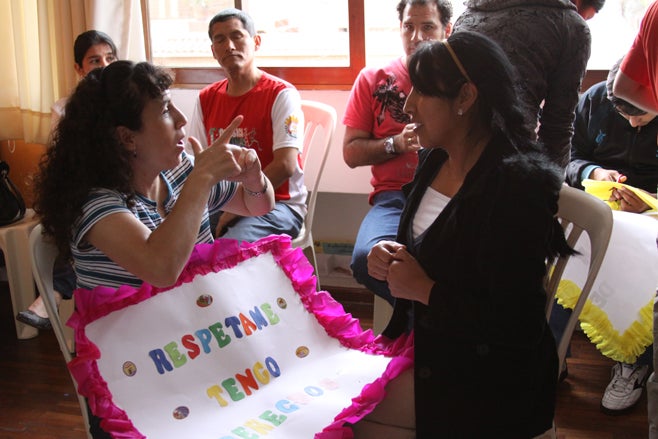
Peru: Disability Rights in the Voting Booth
Peruvians with disabilities are no-less citizens than anyone else. Everyone is equally entitled to vote and participate in society – and the law and government policy should see to it that they have the support they need and that no one is arbitrarily and unjustifiably excluded.
Shantha Rau Barriga, disability rights researcher and advocate
Remove Legal and Policy Barriers to Political and Civic Participation
(Lima) – Peru should remove significant barriers preventing people with disabilities from exercising their right to vote and other civil rights, Human Rights Watch said in a report released today. The failure to dismantle the obstacles is undermining Peru’s leadership as one of the first countries to ratify, in 2008, the Convention on the Rights of Persons with Disabilities.
The 89-page report, “‘I Want to be a Citizen Just Like Any Other’: Barriers to Political Participation for People with Disabilities in Peru,” documents the legacy of a policy, changed only in October 2011, that arbitrarily denied people with sensory, intellectual, and psychosocial disabilities their right to vote, considering them legally incompetent to exercise such a decision. Human Rights Watch also examined the barriers that people with these and other disabilities face when exercising their political rights, including the difficulty of getting identity documents essential for voting, and the absence of support mechanisms to help people with disabilities make voting decisions.
“Peruvians with disabilities are no-less citizens than anyone else,” said Shantha Rau Barriga, disability rights researcher and advocate at Human Rights Watch. “Everyone is equally entitled to vote and participate in society – and the law and government policy should see to it that they have the support they need and that no one is arbitrarily and unjustifiably excluded.”
The report is based on interviews with more than 100 people with disabilities and their families, as well as with Peruvian government officials and disability advocates.
The report examines how the country’s system of judicial interdiction – which places people under guardianship – and public records that officially identify people as “mentally disabled” create obstacles in practically all spheres of life. Such policies can: prevent people from opening a bank account, getting a job, owning or inheriting property, getting married, or signing official documents on behalf of their children.
Under the system of interdiction, Peru’s civil code allows a judge to declare a person with certain intellectual or mental disabilities incompetent to take care of his or her self and property and to impose another person as guardian to act on the person’s behalf. The process effectively suspends the civil rights of the person placed under guardianship, Human Rights Watch said.
However, Article 12 of the Disability Rights Convention states that people with disabilities should “enjoy legal capacity on an equal basis with others in all aspects of life.” The committee that monitors the Disability Rights Convention has called on the Peruvian government to “abolish the practice of judicial interdiction.”
“I have the right to vote; I have the right to work,” said Maria Alejandra Villanueva, a leader of the Peruvian Association of People with Down Syndrome. “It’s not someone else’s decision.”
The Organization of American States’ (OAS) Committee for the Elimination of all Forms of Discrimination against Persons with Disabilities has called on states parties, including Peru, to ensure the recognition of everyone’s legal capacity, including people with disabilities, for example by replacing interdiction and related practices with supported decision-making.
Peru has no system in place to support people with disabilities in making their own decisions. In the absence of such a mechanism, Human Rights Watch found that family members of people with disabilities had sought guardianship because they perceived it to be the only way under Peruvian law to protect their property or legal interests, including their right to a pension or social security benefits.
People with disabilities in Peru may also face physical and other barriers when they seek to exercise their right to vote. Peru’s election law requires officials to provide accessible voting facilities. However, the government has a mixed record in this regard, Human Rights Watch found. People with physical disabilities and election monitors told Human Rights Watch that many polling places were inaccessible.
Silvia, a woman with a physical disability in Puno, told Human Rights Watch, “The polling stations are not prepared for people with disabilities, or even people who had an accident a few days earlier,” she said. “They are on the second and third floor. They are not accessible for someone in a wheelchair.”
Human Rights Watch also received reports that braille ballots, which must be provided by law, were not available in some polling places during the 2010-2011 municipal and presidential elections. Some people with disabilities who had asked for assistance in voting were not able to get help, they told Human Rights Watch.
People with psychosocial and intellectual disabilities face additional barriers and challenges in voting, Human Rights Watch found. The government has produced no election materials to facilitate their participation. And government officials, civil society organizations, and citizens who administer or monitor elections have little guidance on how to ensure that these voters can reach the polls and cast their vote.
“The government needs to make sure that election staff are able to support the right of people with disabilities to vote,” said Barriga. “Otherwise, the voices of thousands of Peruvians will continue to be excluded from the political process.”
To meet Peru’s obligations under international law, Congress should act promptly to pass new legislation to ensure compliance with the Disability Rights Convention, Human Rights Watch said. The government should also take swift steps to guarantee that all people with disabilities have equal legal capacity, including by amending the civil code and restoring civil rights to those under guardianship.
In addition, Peruvian government ministries and agencies should systematically work with people with disabilities and organizations that represent people with disabilities to develop new approaches to supported decision-making and the implementation of legal reforms, Human Rights Watch said.
Over the past decade, the Peruvian authorities systematically excluded over 23,000 people with intellectual or psychosocial disabilities from the voter registry, Human Rights Watch said. The people were excluded either because they were unable to obtain a national identity card, which is required for voting, or because they were issued identity cards that designated them “mentally disabled” and thus not entitled to vote or make other legal, financial, and even personal decisions.
In October 2011, after years of pressure from disability organizationsand intervention by the ombudsman’s office, the National Registry for Identification and Civil Status (RENIEC), one of the government agencies responsible for elections, issued a resolution to nullify this policy and pledged to work with relevant government agencies to address this situation promptly.
International civil society, donors, and United Nations agencies active in the area of good governance, civic engagement, and democracy building in Peru should include people with disabilities as part of their analysis or as a focus of their work. Human Rights Watch said.
“The government has declared its intentions to give people with disabilities their full rights,” Barriga said. “Now it needs to follow through so that Peruvians with disabilities can exercise their citizenship rights just like everyone else.”
The 89-page report, “‘I Want to be a Citizen Just Like Any Other’: Barriers to Political Participation for People with Disabilities in Peru,” documents the legacy of a policy, changed only in October 2011, that arbitrarily denied people with sensory, intellectual, and psychosocial disabilities their right to vote, considering them legally incompetent to exercise such a decision. Human Rights Watch also examined the barriers that people with these and other disabilities face when exercising their political rights, including the difficulty of getting identity documents essential for voting, and the absence of support mechanisms to help people with disabilities make voting decisions.
“Peruvians with disabilities are no-less citizens than anyone else,” said Shantha Rau Barriga, disability rights researcher and advocate at Human Rights Watch. “Everyone is equally entitled to vote and participate in society – and the law and government policy should see to it that they have the support they need and that no one is arbitrarily and unjustifiably excluded.”
The report is based on interviews with more than 100 people with disabilities and their families, as well as with Peruvian government officials and disability advocates.
The report examines how the country’s system of judicial interdiction – which places people under guardianship – and public records that officially identify people as “mentally disabled” create obstacles in practically all spheres of life. Such policies can: prevent people from opening a bank account, getting a job, owning or inheriting property, getting married, or signing official documents on behalf of their children.
Under the system of interdiction, Peru’s civil code allows a judge to declare a person with certain intellectual or mental disabilities incompetent to take care of his or her self and property and to impose another person as guardian to act on the person’s behalf. The process effectively suspends the civil rights of the person placed under guardianship, Human Rights Watch said.
However, Article 12 of the Disability Rights Convention states that people with disabilities should “enjoy legal capacity on an equal basis with others in all aspects of life.” The committee that monitors the Disability Rights Convention has called on the Peruvian government to “abolish the practice of judicial interdiction.”
“I have the right to vote; I have the right to work,” said Maria Alejandra Villanueva, a leader of the Peruvian Association of People with Down Syndrome. “It’s not someone else’s decision.”
The Organization of American States’ (OAS) Committee for the Elimination of all Forms of Discrimination against Persons with Disabilities has called on states parties, including Peru, to ensure the recognition of everyone’s legal capacity, including people with disabilities, for example by replacing interdiction and related practices with supported decision-making.
Peru has no system in place to support people with disabilities in making their own decisions. In the absence of such a mechanism, Human Rights Watch found that family members of people with disabilities had sought guardianship because they perceived it to be the only way under Peruvian law to protect their property or legal interests, including their right to a pension or social security benefits.
People with disabilities in Peru may also face physical and other barriers when they seek to exercise their right to vote. Peru’s election law requires officials to provide accessible voting facilities. However, the government has a mixed record in this regard, Human Rights Watch found. People with physical disabilities and election monitors told Human Rights Watch that many polling places were inaccessible.
Silvia, a woman with a physical disability in Puno, told Human Rights Watch, “The polling stations are not prepared for people with disabilities, or even people who had an accident a few days earlier,” she said. “They are on the second and third floor. They are not accessible for someone in a wheelchair.”
Human Rights Watch also received reports that braille ballots, which must be provided by law, were not available in some polling places during the 2010-2011 municipal and presidential elections. Some people with disabilities who had asked for assistance in voting were not able to get help, they told Human Rights Watch.
People with psychosocial and intellectual disabilities face additional barriers and challenges in voting, Human Rights Watch found. The government has produced no election materials to facilitate their participation. And government officials, civil society organizations, and citizens who administer or monitor elections have little guidance on how to ensure that these voters can reach the polls and cast their vote.
“The government needs to make sure that election staff are able to support the right of people with disabilities to vote,” said Barriga. “Otherwise, the voices of thousands of Peruvians will continue to be excluded from the political process.”
To meet Peru’s obligations under international law, Congress should act promptly to pass new legislation to ensure compliance with the Disability Rights Convention, Human Rights Watch said. The government should also take swift steps to guarantee that all people with disabilities have equal legal capacity, including by amending the civil code and restoring civil rights to those under guardianship.
In addition, Peruvian government ministries and agencies should systematically work with people with disabilities and organizations that represent people with disabilities to develop new approaches to supported decision-making and the implementation of legal reforms, Human Rights Watch said.
Over the past decade, the Peruvian authorities systematically excluded over 23,000 people with intellectual or psychosocial disabilities from the voter registry, Human Rights Watch said. The people were excluded either because they were unable to obtain a national identity card, which is required for voting, or because they were issued identity cards that designated them “mentally disabled” and thus not entitled to vote or make other legal, financial, and even personal decisions.
In October 2011, after years of pressure from disability organizationsand intervention by the ombudsman’s office, the National Registry for Identification and Civil Status (RENIEC), one of the government agencies responsible for elections, issued a resolution to nullify this policy and pledged to work with relevant government agencies to address this situation promptly.
International civil society, donors, and United Nations agencies active in the area of good governance, civic engagement, and democracy building in Peru should include people with disabilities as part of their analysis or as a focus of their work. Human Rights Watch said.
“The government has declared its intentions to give people with disabilities their full rights,” Barriga said. “Now it needs to follow through so that Peruvians with disabilities can exercise their citizenship rights just like everyone else.”
Bron : Human Rights Watch
Abonneren op:
Posts (Atom)