 | ||||
Dear Luc,
Richard and I lived together for 3 years and were really happy and deeply in love. One day, he complained about his neck and was soon hospitalized.
They banned me from seeing him. They said I didn't count as family. I was able to sneak into his room for only two minutes. Enough time to hold his hand and tell him that I loved him. He died the next day. I wasn’t allowed to be there.
This happened because we were a gay couple in Peru and there’s no law to protect us. But, next Tuesday there's a vote to decide whether families like mine can be protected with civil unions.
The vote's going to be close but the President's voice could change everything. Will you join me in asking President Humala to publicly support civil unions so that no one else faces what Richard and I did?
https://www.allout.org/peru
Unlike our neighbours, Peru is far behind in recognising basic rights for lesbian, gay, bi and transgender people. This new law is a unique chance to start helping families like mine, who face so much discrimination and abuse every day because we're not protected.
During his Presidential campaign, Humala promised to launch a National Program against Homophobia and to push for a civil unions. But, since the debate started he's been silent, just like many other of the MPs from his party – even though more than 9,000 Peruvians in 6 cities just took to the streets to support civil unions on Saturday.
If thousands more of us inside Peru and around the world speak up before the Tuesday vote, we can grow the energy of those historic protests, spreading it to social media and the news. It could be enough to finally convince President Humala to finally stand up for all of Peru's families and make sure civil unions get approved in Congress.
Click here to ask President Ollanta Humala to stand up for equality:https://www.allout.org/peru
Last week, thousands of All Out members sent emails straight to the MPs from the Committee and convinced a few undecided voters to make the right choice. But there’s still MPs on the fence who might be waiting to see what the President does.
If we can join our voices and speak up right now, we can create the biggest petition ever in Peru's history, making it easier for President Humala to publicly stand for LGBT rights. Each battle we've won for equality reminds those who are fighting that still there is hope.
I'm adding my name to the petition in memory of Richard. Will you join me?https://www.allout.org/peru
Thank you.
Roberto and the rest of the All Out team.
SOURCES (in Spanish):
Same sex Civil Union supporters march in Lima - Peruvian Times, 14 April, 2014
http://www.peruviantimes.com/14/same-sex-civil-union-supporters-march-in-lima/21986/
Same sex Civil Union measure sparks controversy in Peru - FoxNews, March 31st, 2014
http://latino.foxnews.com/latino/news/2013/10/05/same-sex-civil-union-measure-sparks-controversy-in-peru/
Peru's Excecutive Power supports gay Civil Union bill - In Spanish - SentidoG, March 28th, 2014
http://www.sentidog.com/lat/2014/03/ejecutivo-de-peru-avala-proyecto-de-union-civil-homosexual.html
Justice Ministry backs up the Civil Union bill - In Spanish - El Comercio, March 26th, 2014
http://elcomercio.pe/politica/congreso/ministerio-justicia-respalda-proyecto-union-civil-noticia-1718469 | ||||
| ||||

Posts tonen met het label Peru. Alle posts tonen
Posts tonen met het label Peru. Alle posts tonen
maandag 21 april 2014
2 minutes to say goodbye - Peru - World




zondag 14 oktober 2012
Peru, Libertarian Socialist Union (USL) Bolet?n Lucha Libertaria #19 (ca)
To build a Libertarian Socialist America! ---- October 12, nothing to celebrate, much to
fight --- Now we can say that the settlers and murderers of yesterday are the same today,
governments are anti-popular policies of hunger and misery, is seeking transnational
geopolitical expansion to greater economic domination are mining companies that exploit,
pollute and kill the land and the people, in short, is the capitalist system and its
various faces buts same: neoliberalism, imperialism, colonialism, globalization.-- Lucha
Libertarian Bulletin No. 19 ---- It is no secret that the current development of
capitalism has turned into a deep "economic crisis", which is intended to solve the
looting of social funds from the public treasury, the savings of millions of workers, of
the enslavement financial resources of minerals, biological and energy, using
sophisticated mechanisms misappropriation and puppet governments in the service of
transnational corporations.
All these facts, of course, left a grim picture of poverty, deprivation, exclusion,
transgenic poisons and contaminated communities and displaced aggressively increasing the
extermination of our nature by the progressive elimination of pure water sources and
large-scale air contaminaci?ndel .
That is, our peoples are being dispossessed of their lands, natural resources and
constantly attacked, the situation is even worse for communities in voluntary isolation,
as in the live zonasdonde usually found hydrocarbons, metals, biodiversity, etc..
Furthermore, we note that the history of these peoples has been resistance to these
attacks, even as colonial ordinances for ownership of subsoil resources, land law
easements, Rural Communities Act, Convention 169 ILO best known as the "Consultation",
etc., this historical dispossession also manifested in cultural heritage, tangible
(archaeological), intangible (cultural and ancestral knowledge production) which have
become collectors' items, patents and other exfoliaci?n.Por forms thus we face a situation
of extreme importance because it is the defense of one's life and future for humanity.
Amidst all this, do not forget that while the officers of "culture" and alienating
bourgeois celebrates October 12 as "Day of the discovery of America" ??or worse as
"Columbus Day" (a clear expression of domination West over our region), the peoples
combative sectors in Latin America struggle and rebel take to the streets to mobilize in
defense of our cultures that were trampled and overrun by brutal European settlers just
one October 12, 1492. What we experienced in our entire American meddling Morena was a
wild and genocide of entire peoples in the name of "civilization, culture and thinking",
was razed by fire and sword expressions of biodiversity rich ancestral knowledge and
experience, to impose barbarism and looting.
Now we can say that the settlers and murderers of yesterday are the same today,
governments are anti-popular policies of hunger and misery, is seeking transnational
geopolitical expansion to greater economic domination are mining companies that exploit,
pollute and kill the land and the people, in short, is the capitalist system and its
various faces buts same: neoliberalism, imperialism, colonialism, globalization,.
In our country, we are under the same regime continuity in both the free market model
(privileges for the few, poverty and unemployment for many), as in the political and
repressive model that does not hesitate to impose management Ollanta Humala. In Peru, the
recent peak of social struggle is experienced as a result of social protest against the
Conga mining project in Cajamarca, which has triggered a new wave of criminalization of
protest, killing brothers and fellow villagers. As we know, the constant protests drove
back to the government in an effort to impose authoritarian or yes Conga, and although
this project has not been entirely eliminated, Yanacocha and the government have said they
are only suspended, it should be mentioned that the rejection Conga and the supposed
benefits of extractive and primary export model is strong across the country. In
Cajamarca, a recent survey reveals that 73.4% of people say they should not go Conga "no
way", and 61.1% are against the mining project (just 3.4% in favor) and will support calls
for new strikes. Meanwhile, more than half of the population (50.2%) say they have
participated in marches against Conga and 82.4% think that only the company Yanacocha is
the beneficiary.
And in context of protests framed in current social conflicts in the country, it is known
that there are more than 164 active cases, according to the Ombudsman. Of the total
number, 148, indicates that conflicts are socio-environmental and the Andean regions of
Ancash and Puno have as many of these.
Within the bulk of protests by social unrest we have not only environmental issues, but
there is a long list of issues ranging from labor issues with redundant, underemployment,
outsourcing, anti-union harassment, etc.. (As the current development of the productive
process, causes a reduction in the need for labor becomes more affordable or more) human
rights, social justice, anti-privatization and commercialization of education, minority
claims excluded , etc. All these cases are within the larger context of resistance to a
socio-economic life precarious us, denying us the right to express ourselves freely and
trying to impose a single model of sustained development in the accumulation of private
property, wars colonization and persecution of dissident ideas.
Also, understand that this critical situation not only has to do with our country, but is
part of a global trend that is accentuated with force called the "third world" through the
propaganda of imperialist domination and its spokesmen oligarchs , liberal, populist
right-wing or "left" in one way or another seek lotizar our regions for the best use of
natural, environmental deterioration generating more pollution, abundant demand,
production and consumption of energy, production of goods, waste and scrap, largely toxic,
etc..
Countries with an exquisite wildlife biodiversity, through forests, mangroves,
rainforests, grasslands, etc.., Spaces affected by multinationals enjoying economic
alliances with local governments give them oil, water, threatening our food sovereignty,
among other things, under the illogical produce, produce and re-produce increasingly
unstoppable, insatiable and growing criminal industry and unnatural.
For all this and more, who are part of the working and exploited say that it is time to
say enough, to stop capitalist greed and complicity of states of the world in the
destruction of our planet. We are aware of the total failure of bourgeois policy in all
its variants (parliamentary, representative "democracy", electioneering political parties
of left and right, etc.) That only favor the ruling class and seek to deceive us with
false sets of "nationalism" , "opposition", "citizen power", "great transformation",
"welfare and populism" (all these projects we infiltrate politicians, divided, sectioned,
and end when elected, relying on legislation made by "them" to measure of "them" usurp the
exercise of power that is not theirs, to decide for us, and they do against our interests).
It is necessary to identify the branches of government that are truly Domination System
(judiciary, executive, legislature, Attorney General, Ombudsman, Comptroller General of
the Republic National Electoral Office and the National Elections) therefore are instances
to serve the masters of the country and their imperialist masters. Then it is our duty to
build new and better ways of social organization, from below and from all.
It is urgent to build a project that meets the challenges of our time. This process should
be based on true direct democracy mechanism of masses, horizontality to build permanent
popular assemblies, in the socio-economic self-management as genuinely anti-capitalist and
revolutionary tool for the control of the means of production, organized direct action for
resolving social conflicts and environmental social, internationalism to understand that
the common enemy is Capitalism and the State in the world, solidarity between each
village, community, industry, union, struggling man or woman.
That is, dare to take the reins of our lives to the powerful who believe that we must pay
the consequences of economic crises or their imperialist wars, daring to move with drive
from the fight and advance social processes from the bottom up, dare to face the power of
the media, military, religious, political, through the strengthening of our capacity for
self-organization and mobilization, or through People's horizontal and libertarian.
BUILD worthy people, free and united
Autonomy and direct democracy!
BY A SOCIALIST AMERICA AND LIBERTARIAN!
FIGHT, BUILD, POWER POPULAR!
THE UP AND FIGHTING!
Related Link: http://uslperu.blogspot.com/
Bron : a-infos-en@ainfos.ca
vrijdag 17 augustus 2012
(en) Peru: not another death for protesting by Union Socialista Libertaria - USL
With the recent deaths sought by the reactionaries, which are the culmination of the
protest. Incredibly, the perpetrators seek to turn themselves into victims. What happened
in Cajamarca, as well as the case of Bagua, to mention just two symbolic cases, were
MASSACRES, which have the blood-stained hands of the current Ollanta Humala government and
his Valdes cabinet, who did not hesitate to declare States of Emergency for greater social
control, and to show their true neo-liberal, repressive, pro-imperialist and anti-popular
face. ---- In these times of struggle we direct ourselves to our rebellious people, to
express our total opposition to the massacre that has been perpetrated in Cajamarca,
against common brothers whose only "crime" was daring to fight for what they believed
just. The bullets of capitalist reaction, the impact of state repression and the indolent
violence of transnational mining, that wants to impose Conga at any price, had a thirst
for blood and have claimed new victims:
We never forget: Cesar Medina Aguilar (17), Jos? Antonio S?nchez Huam?n (29), Faustino
Silva S?nchez Jos? (35), Eusebio Garc?a Rojas (48), all those of Celend?n and Joselito
V?squez Jambo (28) of Bambamarca. We are confident that their deaths will not be in vain,
for every blow the people receives better prepares us for the next fight, because the fear
is past.
"They killed them for defending the water and for defending life!", is the spirit which
has swollen the breasts and throats of the protesters in each slogan. The enemies of the
people dreamed that the blood spilled would scare off the protest or disturb the reason
and action of the conscious and rebellious spirits that struggle for social demands that
are human rights that we will never cease to defend, to the last breath of our lives.
Cajamarca, Espinar, Puno and all the combative people of the present hour, of yesterday
and those soon to be raised, are our banner, our example and our hope. Therefore, now more
than ever, Conga will not pass! Conga won't be! And with the same strength and conviction
we say that Xtrate and Toromocho will also not pass!
Also the recent deaths sought by the reactionaries, which are the culmination of the
protest. Incredibly, the perpetrators seek to turn themselves into victims. What happened
in Cajamarca, as well as the case of Bagua, to mention just two symbolic cases, were
MASSACRES, which have the blood-stained hands of the current Ollanta Humala government and
his Valdes cabinet, who did not hesitate to declare States of Emergency for greater social
control, and to show their true neo-liberal, repressive, pro-imperialist and anti-popular
face.
These events are also a logical consequence of the increasing CRIMIALISATION OF SOCIAL
PROTEST, launched globally by capitalism to defend its system in slow agony, even more so
after the last great general crisis in the Age of Globalisation.
Nationally, within the repressive policies implemented by the Executive Power itself under
cover of legislative faculties granted by the Congress of the Republic, the Aprista
government enacted the Legislative Decree 982, which amended several articles of the Penal
Code, specifically article 20 in order to declare immunity from prosecution. That is, that
"are exempt from criminal liability: Staff of the Armed Forces and the National Police of
Peru, which in the line of duty use their weapons in accordance with regulations,
resulting in injury or death". The present government is, therefore, not only in economic
policy but also in repressive policy the same NEO-LIBERAL CONTINUATION, which will always
need to criminalise all popular protest in order to continue implementing their plans for
massive layoffs, lack of labour and social rights, privatisation of public services, the
concentration of big land ownership in the hands of groups of economic power, sacrifice of
resources and raw materials for the indiscriminate extractive activity of big transitional
property, etc.
The main tendency is then to continue producing even more massacres and deepening
sanctions against protesters, alongside a major "MEDIA CRIMINALISATION" on the part of
"communication" companies and "journalists" financed by big capital, in order to justify
the repressive actions and to mask the reality of all this: state terrorism. One must be
blind not to see that the deepening of neo-liberal policies in a context of crisis of the
system will sooner or later generate a shift towards a fascist resurgence, that we have
here warned of.
Faced with this, what is the option of the proletariat, the peasantry and other oppressed
sections of the people? A political solution (electoral and reformist) within bourgeois
democracy has already proven unviable. The main proof is the current government, which
managed to assume the administration of the state at an electoral rate mainly of popular
sectors and with the alliance of almost all the Marxist and populist left. Leaders of
political and labour organizations managed by said "left" have since the beginning of this
government occupied strategic posts, in the Legislative and Executive Power, which means
they have achieved their longtime aspired goal: to be government, take over state power,
with the same result: CONTINUATION OF NEO-LIBERALISM. This, despite the fact that some
electoral parties continue bamboozling their bases and activists with a false radicalism,
infiltrating or trying to direct social protests, only to look for media prominence in
order to win votes in the face of 2016 to then become agents of the political and economic
power groups subservient to capitalism.
Consequently, there is only one popular alternative and it is already being exercised,
germinating and being implanted in the heart of the protest: DIRECT ACTION. That is the
effective exercise of popular power against the power of the state. That the rebellion is
generalized, that the popular assemblies, that the communities of struggle and resistance
flourish from the squares and streets liberated for the people, in every humble barricade
that is raised on the roads, in neighborhoods, in hearts and minds.
What the population itself is doing in Cajamarca, in Espinar, in Puno, Ayacucho and
various other parts of the country where the people fight for their rights, surpassing the
leadership and bureaucratic and opportunists unions is precisely to exercise mass direct
action and democracy. Breaking with all kinds of mediation in order to snatch their rights
and break the unpunished repression on the part of the state. It is certain that is is a
struggle of demand, but is fertilising and baptising by fire popular forces towards higher
horizons of social emancipation.
We conclude these lines reaffirming our militant and libertarian commitment with the
people of which we are part and from which we struggle. We urge all brothers in struggle
not to leave their fighting posts. The demonstrations should continue and unity in
struggle must lead the way to beat back the forces of repression. The lakes and natural
reservoirs are part of the ecosystem itself and do not belong to any mining company and
nor will all economic power cause the fighting people to give in in their efforts to
protect life. It is clear, once again, that the best government is one that doesn't exist,
that every president acts on the basis of market interests. Only the organized people
point the way.
Down with the state of emergency in Celendin, Bambamarca and Hualgayoc!
Transnational mining companies out of our communities!
The blood spilled will never be forgotten!
Humala, Valdes, servants of mining capital, murderers of the people!
Direct action, solidarity and self-management against capitalism and its servants!
Bron :
LIBERTARIAN SOCIALIST UNION (USL)
Translation: Jonathan, ZACF
Related Link: http://www.anarkismo.net/article/23335
donderdag 14 juni 2012
WARM ONTHAAL HUMALA IN BRUSSEL : CONGA NO VA! ABAJO EL TLC !

Op dinsdag 12 juni bezocht de Peruaanse president Ollanta Humala Brussel voor een korte vergadering met Herman Van Rompuy in kader van het vrijhandelsakkoord dat in september ter ratificatie voorligt in het Europese Parlement. Gezien het groeiende sociale protest tegen het omstreden mijnbouwproject Conga, en dit vrijhandelsakkoord gaven we Humala een warm onthaal in Brussel !
Het volk dat de eerste linkse president van Peru aan de macht bracht in juli vorig jaar, ziet de autoritaire traditie opnieuw opduiken. Huidige sociale bewegingen worden hard onderdrukt, zo blijkt uit de gebeurtenissen rond het omstreden grootschalige mijnbouw project Conga.
Naar aanleiding van zijn flitsbezoek aan Brussel, gaven we president Ollanta Humala een warm onthaal vorige dinsdag 12 juni met een solidariteitsactie aan Schuman.
De actie haalde ook de pers in Peru: er verscheen een artikel en beelden in de Peruaanse krant El Comercio.
Ziehier de persconferentie van Van Rompuy en Humala na hun ontmoeting.
In De Standaard verscheen n.a.v. de actie een achtergrondartikel 'Niet al dat goud is, blinkt'.
Lees meer over Humala in het artikel 'President Humala maakt een bocht van 180°'
Hieronder enkele foto's, een video van de actie volgt! en alvast de nieuwsuitzending
Petitie nog niet ondertekend? Doe dat dan nu hier 'Vrijhandelsakkoorden, vrij voor wie?'
Bron : Vero / www.intal.be
woensdag 13 juni 2012
PRESIDENT HUMALA MAAKT BOCHT VAN 180°
CRIMINALISERING VAN SOCIAAL PROTEST IN PERU
Het volk dat de eerste linkse president van Peru aan de macht bracht in juli vorig jaar, ziet de autoritaire traditie opnieuw opduiken. Huidige sociale bewegingen worden hard onderdrukt, zo blijkt uit de gebeurtenissen rond het omstreden grootschalige mijnbouw project Conga.

« Conga no va ! »
“Conga no va!” - Conga komt er niet door - op de cadans van deze slogan groeit het sociaal protest in Peruaanse Andes. Het begon toen het project Minas Conga, een uitbreiding van Yanacocha, in oktober 2010 groen licht kreeg van het ministerie van energie en mijnbouw, toen nog onder president Alan García. In juli 2011 maakt Newmont Mining, de hoofdaandeelhouder van Yanacocha, bekend dat de financiering rond is. Sindsdien volgen de protestacties elkaar in snel tempo op. Het Conga-project is het eerste grote milieuconflict waarmee de regering van Humala te maken krijgt.
Maar de regering, die verkozen werd door links en de arme bevolking van de Andes, kiest nu de kant van de multinationals tegen de belangen in van de plaatselijke bevolking! In zijn verkiezingscampagne had Ollanta Humala nochtans beloofd dat hij een eerlijke verdeling van de mijnopbrengsten wou, een strengere milieuwetgeving en meer sociale investeringen. Daar komt niets van in huis. De met veel omhaal aangekondigde “Grote Transformatie van het Land”, komt er niet.
De grote ommezwaai
Al heel snel maakte Ollanta Humala een politieke bocht. Na het ontslag van eerste minister Lerner in december 2011, legde ex-militair Oscar Valdes de eed af… om de confrontatie aan te gaan met de ontluikende sociale protesten. De nieuwe premier kreeg direct de steun van rechts, met name van de pas verslagen presidentskandidaat Keiko Fujimori, dochter van de gelijknamige ex-dictator. Linkse ministers werden vervangen en Humala kreeg de steun van de elite die de touwtjes in handen hebben in de financiële sector en de mijnsector. Ook de militaristische en neoliberale contreien die hem vroeger verafschuwden, uiten hun steun aan Humala.
Met een kapitaal van 4 miljard dollar is het Conga-project de belangrijkste mijnbouwinvestering ooit in het land. Het gaat om een uitbreiding van de Yanacocha-mijn, de grootste goudmijn van Latijns-Amerika. Lima stelt dat Conga noodzakelijk is voor de verdere economische groei van Peru, maar in Cajamarca, in het Noorden van Peru, denken ze daar anders over: 78% van de bevolking is er afhankelijk van de landbouw en de veeteelt. Water is voor hen van het grootste belang. De vernietiging van vier bergmeren door het project staat dan ook centraal in het protest, dat gesteund wordt door de regionale overheid.
Gewelddadige repressie van sociaal protest
Een algemene staking van onbepaalde duur die op 31 mei in de regio van Cajamarca begon, dijnde uit naar de meeste andere regio’s. De manifestanten eisen dat het Conga-project wordt stopgezet. Met de algemene staking en de wegblokkades nam ook de politierepressie in Cajamarca toe. Vreedzame manifestaties werden met geweld onderdrukt. Er vielen meerdere gewonden en er lopen juridische vervolgingen tegen minstens 41 personen. Omdat de gouverneur zelf tot het protest had opgeroepen wordt ook hij nu juridisch vervolgd. Diegenen die hem nu voor het gerecht willen brengen, vergeten dat ook Ollanta Humala in 2005 opriep tot opstand tegen de regering van een van zijn voorgangers, Alejandro Toledo.
Het goede nieuws is dat links, dat Humala in 2011 nog aan de verkiezingsoverwinning hielp, zich op 21 mei groepeerde in een links verkiezingsfront onder de naam “Movimiento de Afirmacion Social” (MAS) (beweging van sociale bevestiging).
1800 kilometer verder, zelfde realiteit
1800 kilometer zuidwaarts van Cajamarca, werd de burgemeester van de stad Espinar, in de provincie Cusco, aangehouden. Oscar Mollohuanca, was een van de organisatoren van de manifestatie eind mei tegen de ontginning van de Mina Tintaya. De rechter veroordeelde hem tot vijf maanden gevangenisstraf. In het conflict in Espinar zijn al vier doden gevallen. De mijn van Tintaya, die sinds 1997 wordt uitgebaat, vervuilt de rivieren in de regio. Ngo’s vonden een hoge concentratie van lood, koper, arsenicum en cadmium in het water. Dat veroorzaakt grote sterfte onder de kuddes in de streek. En er werden al misvormde baby’s geboren. De stad Espinar, waar in juni 2011 nog 76 % van de kiezers voor Humala stemde - het nationale gemiddelde was 52% - beseft nu dat de president hen met valse beloftes bedot heeft.
En dus een vrijhandelsakkoord ...
De EU is de tweede belangrijkste handelspartner van de Comunidad Andina (CAN 1). 45 % van de export van de CAN naar Europa bestaat uit brandstoffen en mijnbouwproducten. De mijnbouwindustrie is goed voor 60% van de export van het land. Ze speelde een belangrijke rol in de recente economische groei van Peru. Maar van die groei merken de mensen die dag in dag uit werken om te overleven niets. In 2012 stemt het Europees Parlement over een vrijhandelsakkoord tussen de EU en Peru. Om daarover te discussiëren met Herman Van Rompuy kwam Ollanta Humala deze week naar Brussel. De stopzetting van de repressie stond niet op de agenda.
Intal maakte van de gelegenheid gebruik om op 12 juni op het Schumanplein, in samenwerking met de vzw’s Catapa, El Andino en Quinoa, een solidariteitsactie te organiseren met de mijnprotesten in Conga en tegen het vrijhandelsakkoord.
1. CAN: Venezuela, Colombia, Peru, Ecuador, Bolivia
in samenwerking met H. Gautresona
Bron : Intal
woensdag 6 juni 2012
SOLIDARITÉ AVEC LES PROTESTATIONS MINIÈRES AU PÉROU
CONGA NO VA! NO AL TLC ! APPEL À UNE ACTION DE SOLIDARITÉ
START: 12/06/2012 - 17:30

Le mardi 12 juin, le président péruvien Ollanta Humala sera à Bruxelles pour une rencontre avec le président européen Herman Van Rompuy. En solidarité avec les protestations de la population péruvienne qui se bat pour ses droits humains et pour l'environnement, nous appelons à une manifestation pacifique en face du Conseil Européen ensemble avec l'asbl CATAPA et Quinoa. Conga no va! No al TLC!
Au Pérou, des projets miniers à grande échelle mènent à des conflits sociaux dans tout le pays. Le 28 mai, il y a eu deux morts dans des protestations contre une mine de cuivre de la société suisse XStrata, située à Espinar, Cusco. Dans la région de Cajamarca la population lutte contre le projet de Conga, une extension de la mine d'or de Yanacocha qui appartient à l'entreprise américaine Newmont. Il y a trois ans, le 5 juin 2009, il y a eu plus de 30 morts dans le Nord du Pérou suite au conflit entre le gouvernement et les peuples autochtones au sujet des concessions pour l'exploration pétrolière - entre autres pour des sociétés européennes telles que Repsol et Perenco. Il y a d’autres géants européens qui ont des opérations minières au Pérou hormis XStrata. Nous y retrouvons Nyrstar ~entreprise belge~, Glencore, BHP Billinton, Rio Tinto et Anglo American.
En réponse aux protestations des communautés locales et des organisations sociales contre l'expansion incontrôlée des industries extractives, le gouvernement péruvien a utilisé une stratégie de criminalisation et de répression sévère. Des dirigeants sont arrêtés sans motif. Ils courent le risque de subir des abus et d'avoir des procès inéquitables. Le gouvernement utilise l'armée contre des manifestants pacifiques et a instauré à deux reprises ces derniers mois un état d'urgence dans les régions où ont lieu les manifestations minières - une tactique maladroite pour agir dans l'impunité et sécuriser les investissements des grandes entreprises.
Les gouvernements de l'Union européenne et du Pérou ont signé un accord de libre-échange le 31 mai de l'année passée. L'accord supprime toutes les barrières commerciales entre l'UE et le Pérou. Il envisage de renforcer la compétitivité de l'Europe et encourage les investissements européens au Pérou, y compris dans les industries du pétrole et des mines. En septembre, la ratification de ce traité sera soumise au vote au Parlement Européen. Les droits environnementaux et humains sont à peine mentionnés dans cet accord.
Le mardi 12 juin, le président péruvien Ollanta Humala sera à Bruxelles pour une rencontre avec le président européen Herman Van Rompuy. En solidarité avec les protestations de la population péruvienne qui se bat pour ses droits humains et pour l'environnement, nous appelons à une manifestation pacifique en face du Conseil Européen.
Nous demandons:
La fin de la criminalisation des protestations des mouvements sociaux qui rejettent les projets d'exploitation minière au Pérou, plus précisément à Cajamarca et à Espinar.
Nous relayons la demande des mouvements sociaux d'annuler le projet Conga à Cajamarca, de protéger les infrastructures de distribution d'eau et de respecter le développement local de la population.
Une condamnation par l'Europe des violations des droits de l'homme au Pérou qui sont, en partie, le résultat direct des investissements européens.
Un «Non» clair à l'Accord de libre-échange de la part de nos députés belges européens
Rendez-vous
Une action pacifique se tiendra en face du bâtiment Justius Lipsius (siège du Conseil de l'Europe), 175 Rue de la Loi, Bruxelles (métro Schuman). Rendez-vous mardi 12 juin à 17h30. A 18h30, nous clôturons l'action. Merci d’apporter vos: banderoles, affiches, photos, instruments de musique, ...
Bron :
Organisation
CATAPA asbl & Intal
www.catapa.be
www.intal.be
vrijdag 18 mei 2012
Peru: Disability Rights in the Voting Booth
- Using sign language, Monica, a deafblind woman, expresses her opinion on her right to political participation. She is a member of SENSE International Peru, an NGO working with deafblind people and their families.© 2011 Human Rights Watch
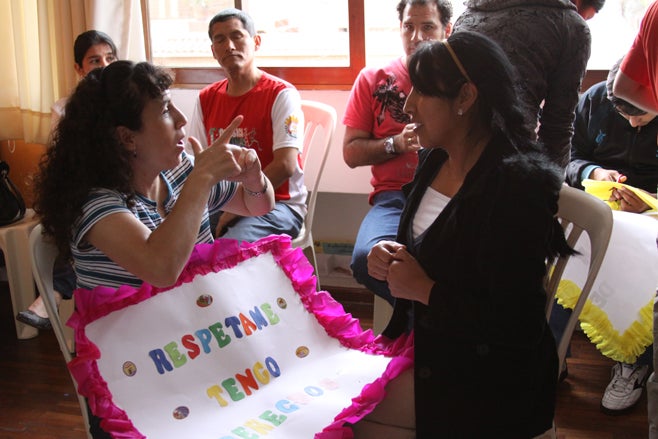

Peruvians with disabilities are no-less citizens than anyone else. Everyone is equally entitled to vote and participate in society – and the law and government policy should see to it that they have the support they need and that no one is arbitrarily and unjustifiably excluded.
Remove Legal and Policy Barriers to Political and Civic Participation
(Lima) – Peru should remove significant barriers preventing people with disabilities from exercising their right to vote and other civil rights, Human Rights Watch said in a report released today. The failure to dismantle the obstacles is undermining Peru’s leadership as one of the first countries to ratify, in 2008, the Convention on the Rights of Persons with Disabilities.
The 89-page report, “‘I Want to be a Citizen Just Like Any Other’: Barriers to Political Participation for People with Disabilities in Peru,” documents the legacy of a policy, changed only in October 2011, that arbitrarily denied people with sensory, intellectual, and psychosocial disabilities their right to vote, considering them legally incompetent to exercise such a decision. Human Rights Watch also examined the barriers that people with these and other disabilities face when exercising their political rights, including the difficulty of getting identity documents essential for voting, and the absence of support mechanisms to help people with disabilities make voting decisions.
“Peruvians with disabilities are no-less citizens than anyone else,” said Shantha Rau Barriga, disability rights researcher and advocate at Human Rights Watch. “Everyone is equally entitled to vote and participate in society – and the law and government policy should see to it that they have the support they need and that no one is arbitrarily and unjustifiably excluded.”
The report is based on interviews with more than 100 people with disabilities and their families, as well as with Peruvian government officials and disability advocates.
The report examines how the country’s system of judicial interdiction – which places people under guardianship – and public records that officially identify people as “mentally disabled” create obstacles in practically all spheres of life. Such policies can: prevent people from opening a bank account, getting a job, owning or inheriting property, getting married, or signing official documents on behalf of their children.
Under the system of interdiction, Peru’s civil code allows a judge to declare a person with certain intellectual or mental disabilities incompetent to take care of his or her self and property and to impose another person as guardian to act on the person’s behalf. The process effectively suspends the civil rights of the person placed under guardianship, Human Rights Watch said.
However, Article 12 of the Disability Rights Convention states that people with disabilities should “enjoy legal capacity on an equal basis with others in all aspects of life.” The committee that monitors the Disability Rights Convention has called on the Peruvian government to “abolish the practice of judicial interdiction.”
“I have the right to vote; I have the right to work,” said Maria Alejandra Villanueva, a leader of the Peruvian Association of People with Down Syndrome. “It’s not someone else’s decision.”
The Organization of American States’ (OAS) Committee for the Elimination of all Forms of Discrimination against Persons with Disabilities has called on states parties, including Peru, to ensure the recognition of everyone’s legal capacity, including people with disabilities, for example by replacing interdiction and related practices with supported decision-making.
Peru has no system in place to support people with disabilities in making their own decisions. In the absence of such a mechanism, Human Rights Watch found that family members of people with disabilities had sought guardianship because they perceived it to be the only way under Peruvian law to protect their property or legal interests, including their right to a pension or social security benefits.
People with disabilities in Peru may also face physical and other barriers when they seek to exercise their right to vote. Peru’s election law requires officials to provide accessible voting facilities. However, the government has a mixed record in this regard, Human Rights Watch found. People with physical disabilities and election monitors told Human Rights Watch that many polling places were inaccessible.
Silvia, a woman with a physical disability in Puno, told Human Rights Watch, “The polling stations are not prepared for people with disabilities, or even people who had an accident a few days earlier,” she said. “They are on the second and third floor. They are not accessible for someone in a wheelchair.”
Human Rights Watch also received reports that braille ballots, which must be provided by law, were not available in some polling places during the 2010-2011 municipal and presidential elections. Some people with disabilities who had asked for assistance in voting were not able to get help, they told Human Rights Watch.
People with psychosocial and intellectual disabilities face additional barriers and challenges in voting, Human Rights Watch found. The government has produced no election materials to facilitate their participation. And government officials, civil society organizations, and citizens who administer or monitor elections have little guidance on how to ensure that these voters can reach the polls and cast their vote.
“The government needs to make sure that election staff are able to support the right of people with disabilities to vote,” said Barriga. “Otherwise, the voices of thousands of Peruvians will continue to be excluded from the political process.”
To meet Peru’s obligations under international law, Congress should act promptly to pass new legislation to ensure compliance with the Disability Rights Convention, Human Rights Watch said. The government should also take swift steps to guarantee that all people with disabilities have equal legal capacity, including by amending the civil code and restoring civil rights to those under guardianship.
In addition, Peruvian government ministries and agencies should systematically work with people with disabilities and organizations that represent people with disabilities to develop new approaches to supported decision-making and the implementation of legal reforms, Human Rights Watch said.
Over the past decade, the Peruvian authorities systematically excluded over 23,000 people with intellectual or psychosocial disabilities from the voter registry, Human Rights Watch said. The people were excluded either because they were unable to obtain a national identity card, which is required for voting, or because they were issued identity cards that designated them “mentally disabled” and thus not entitled to vote or make other legal, financial, and even personal decisions.
In October 2011, after years of pressure from disability organizationsand intervention by the ombudsman’s office, the National Registry for Identification and Civil Status (RENIEC), one of the government agencies responsible for elections, issued a resolution to nullify this policy and pledged to work with relevant government agencies to address this situation promptly.
International civil society, donors, and United Nations agencies active in the area of good governance, civic engagement, and democracy building in Peru should include people with disabilities as part of their analysis or as a focus of their work. Human Rights Watch said.
“The government has declared its intentions to give people with disabilities their full rights,” Barriga said. “Now it needs to follow through so that Peruvians with disabilities can exercise their citizenship rights just like everyone else.”
The 89-page report, “‘I Want to be a Citizen Just Like Any Other’: Barriers to Political Participation for People with Disabilities in Peru,” documents the legacy of a policy, changed only in October 2011, that arbitrarily denied people with sensory, intellectual, and psychosocial disabilities their right to vote, considering them legally incompetent to exercise such a decision. Human Rights Watch also examined the barriers that people with these and other disabilities face when exercising their political rights, including the difficulty of getting identity documents essential for voting, and the absence of support mechanisms to help people with disabilities make voting decisions.
“Peruvians with disabilities are no-less citizens than anyone else,” said Shantha Rau Barriga, disability rights researcher and advocate at Human Rights Watch. “Everyone is equally entitled to vote and participate in society – and the law and government policy should see to it that they have the support they need and that no one is arbitrarily and unjustifiably excluded.”
The report is based on interviews with more than 100 people with disabilities and their families, as well as with Peruvian government officials and disability advocates.
The report examines how the country’s system of judicial interdiction – which places people under guardianship – and public records that officially identify people as “mentally disabled” create obstacles in practically all spheres of life. Such policies can: prevent people from opening a bank account, getting a job, owning or inheriting property, getting married, or signing official documents on behalf of their children.
Under the system of interdiction, Peru’s civil code allows a judge to declare a person with certain intellectual or mental disabilities incompetent to take care of his or her self and property and to impose another person as guardian to act on the person’s behalf. The process effectively suspends the civil rights of the person placed under guardianship, Human Rights Watch said.
However, Article 12 of the Disability Rights Convention states that people with disabilities should “enjoy legal capacity on an equal basis with others in all aspects of life.” The committee that monitors the Disability Rights Convention has called on the Peruvian government to “abolish the practice of judicial interdiction.”
“I have the right to vote; I have the right to work,” said Maria Alejandra Villanueva, a leader of the Peruvian Association of People with Down Syndrome. “It’s not someone else’s decision.”
The Organization of American States’ (OAS) Committee for the Elimination of all Forms of Discrimination against Persons with Disabilities has called on states parties, including Peru, to ensure the recognition of everyone’s legal capacity, including people with disabilities, for example by replacing interdiction and related practices with supported decision-making.
Peru has no system in place to support people with disabilities in making their own decisions. In the absence of such a mechanism, Human Rights Watch found that family members of people with disabilities had sought guardianship because they perceived it to be the only way under Peruvian law to protect their property or legal interests, including their right to a pension or social security benefits.
People with disabilities in Peru may also face physical and other barriers when they seek to exercise their right to vote. Peru’s election law requires officials to provide accessible voting facilities. However, the government has a mixed record in this regard, Human Rights Watch found. People with physical disabilities and election monitors told Human Rights Watch that many polling places were inaccessible.
Silvia, a woman with a physical disability in Puno, told Human Rights Watch, “The polling stations are not prepared for people with disabilities, or even people who had an accident a few days earlier,” she said. “They are on the second and third floor. They are not accessible for someone in a wheelchair.”
Human Rights Watch also received reports that braille ballots, which must be provided by law, were not available in some polling places during the 2010-2011 municipal and presidential elections. Some people with disabilities who had asked for assistance in voting were not able to get help, they told Human Rights Watch.
People with psychosocial and intellectual disabilities face additional barriers and challenges in voting, Human Rights Watch found. The government has produced no election materials to facilitate their participation. And government officials, civil society organizations, and citizens who administer or monitor elections have little guidance on how to ensure that these voters can reach the polls and cast their vote.
“The government needs to make sure that election staff are able to support the right of people with disabilities to vote,” said Barriga. “Otherwise, the voices of thousands of Peruvians will continue to be excluded from the political process.”
To meet Peru’s obligations under international law, Congress should act promptly to pass new legislation to ensure compliance with the Disability Rights Convention, Human Rights Watch said. The government should also take swift steps to guarantee that all people with disabilities have equal legal capacity, including by amending the civil code and restoring civil rights to those under guardianship.
In addition, Peruvian government ministries and agencies should systematically work with people with disabilities and organizations that represent people with disabilities to develop new approaches to supported decision-making and the implementation of legal reforms, Human Rights Watch said.
Over the past decade, the Peruvian authorities systematically excluded over 23,000 people with intellectual or psychosocial disabilities from the voter registry, Human Rights Watch said. The people were excluded either because they were unable to obtain a national identity card, which is required for voting, or because they were issued identity cards that designated them “mentally disabled” and thus not entitled to vote or make other legal, financial, and even personal decisions.
In October 2011, after years of pressure from disability organizationsand intervention by the ombudsman’s office, the National Registry for Identification and Civil Status (RENIEC), one of the government agencies responsible for elections, issued a resolution to nullify this policy and pledged to work with relevant government agencies to address this situation promptly.
International civil society, donors, and United Nations agencies active in the area of good governance, civic engagement, and democracy building in Peru should include people with disabilities as part of their analysis or as a focus of their work. Human Rights Watch said.
“The government has declared its intentions to give people with disabilities their full rights,” Barriga said. “Now it needs to follow through so that Peruvians with disabilities can exercise their citizenship rights just like everyone else.”
Bron : Human Rights Watch
zondag 6 mei 2012
Vrijhandelsakoorden : vrij voor wie ?

Bekijk hier de campagnevideo 'Vrijhandel: vrij voor wie?':
Intal lanceert een campagne tegen het Vrijhandelsakkoord dat wordt afgesloten tussen Europa en Colombia en Peru. Teken de petitie online en verspreid ze!
In september 2007 hebben de regeringen van Colombia, Ecuador, Peru en Bolivia en de Europese Unie onderhandelingen opgestart om een “Associatie Overeenkomst” uit te werken, waarvan de bestanddelen de politieke dialoog, de samenwerking en de handel zijn.
Bolivia en Ecuador zijn vlug uit de onderhandelingen gestapt omdat het werkelijke doel was om tot een Vrijhandelsakkoord (Tratado de Libre Comercio, TLC) te komen, gebaseerd op de NAFTA (North American Free Trade Agreement), dat van kracht is sinds 1994. De dramatische gevolgen van dit laatste akkoord, zowel voor de Mexicaanse werkers als die uit de Verenigde Staten en Canada, waren de beste waarschuwing voor de progressieve regeringen van Bolivia en Ecuador.
Deze laatste zijn bovendien lid van de ALBA (Bolivariaanse Alliantie voor de volkeren van ons Amerika), een akkoord dat werd opgezet door Venezuela en Cuba in 2004 en waar sindsdien meerdere Latijns-Amerikaanse landen bij zijn aangesloten. In dit akkoord staat complementariteit en solidariteitcentraal, eerder dan bikkelharde concurrentie. Zo "exporteert” Cuba bv. zijn medicijnen naar Venezuela en Bolivia en voorzien deze laatsten het Caraïbische eiland van petroleum resp. soja.
Tengevolge van de moeilijkheden om akkoorden met hele regio’s te onderhandelen, heeft de EU zich sinds enkele jaren toegelegd op bilaterale vrijhandelsakkoorden (tussen EU en slechts 1 of 2 andere landen). Deze laten de EU toe om opnieuw eisen op tafel te leggen, waarvan ontwikkelingslanden erin geslaagd waren om ze te blokkeren. Gezien de macht van de Europese multinationals, is het duidelijk wie de winnaar is van dit soort akkoorden.
Vrijhandelsakkoorden tussen landen van ongelijke economische ontwikkeling houden meestal het volgende in:
- De massale import van afgewerkte producten (inbegrepen voedsel) van de rijke landen naar de steeds 'afhankelijker' wordende ontwikkelingslanden.
- De wurging van de lokale industrie en de landbouw van de ontwikkelingslanden, die nochtans noodzakelijk zijn voor hun ontwikkeling.
- Het aantrekken van buitenlands kapitaal voor de ontwikkeling van winstgevende activiteiten, de privatisering van openbare sectoren als onderwijs, gezondheidszorg, transport, watervoorziening.
- De export van primaire grondstoffen, onder economische en politieke voorwaarden, opgelegd door de Europese landen.
- De verhoging van inmenging door de Europese landen op het vlak van veiligheid, politiek en economie.
WIj formuleren dit vrijhandelsakkoord tussen Europa en Colombia/Peru als:
een bedreiging voor de lokale ontwikkeling 
Liberalisering van handel heeft zware gevolgen voor het welzijn van de lokale bevolking. Ze bedreigt de tewerkstelling, de voedselzekerheid, het inkomen, en vergroot de ongelijkheid.
Het voorbeeld van de melksector spreekt boekdelen. Melkproducten staan bovenaan op de lijst producten die Europa naar Colombia en Peru zal exporteren. Europa produceert in 15 dagen een hoeveelheid melk die Colombia in een jaar produceert. 380.000 Colombiaanse melkproducenten dreigen hun inkomen te verliezen.
een bedreiging voor de gezondheid
 Onder invoed van dit akkoord zal de gezondheidssector verder geprivatiseerd worden. De privésector zal zich concentreren op het rijke, lees ‘winstgevende’, deel van de bevolking, waardoor het grootste deel steeds minder toegang heeft tot gezondheidszorg. De gezondheidssector als winstgevende industrie!
Bovendien wil Europa de patenten van geneesmiddelen laten verlengen van 20 naar 25 jaar, dit is 5 jaar langer dan de norm binnen de Wereldgezondheidsorganisatie. De prijs van 'merk'geneesmiddelen kunnen tot 30 keer de prijs bedragen van generische geneesmiddelen. Meer dan 4 miljoen Colombianen riskeren geen toegang meer te hebben tot gezondheidszorg volgens Hai Europe en Mision Salud Colombia. Lees hier hun impact studiein het Engels.
een bedreiging voor de leefomgeving
Dit akkoord verhoogt de druk op de biodiversiteit en natuurlijke rijkdommen van beide landen. De economie is meer exportgericht, dus wordt monocultuur gestimuleerd zoals de palmolie voor biobrandstof. Tegen 2020 wil Europa voor het transport 10% uit biobrandstof halen om haar CO2-uitstoot te verminderen. Een groot deel van de palmolie is afkomstig uit Colombia, ten koste van volledige stukken woud en het inkomen van duizenden boeren.
Daarnaast blijven buitenlandse multinationals de natuurlijke rijkdommen voort plunderen.
een bedreiging voor politieke en sociale rechten
De sociale tegenstellingen in de maatschappij worden met dit soort akkoorden verscherpt. Waar de sociale ongelijkheid toeneemt, stijgen ook de mensenrechtenschendingen. Colombia is nu al het gevaarlijkste land voor syndicalisten en mensenrechtenactivisten. Volgens Amnesty International werden dit jaar alleen al 29 mensenrechtenactivisten en 18 syndicalisten vermoord in Colombia. We zien dus geen verandering sinds de nieuwe president Santos. Daarnaast telt Colombia meer dan 50.000 verdwijningen en 3,5 miljoen interne vluchtingen. Wij vinden het absoluut niet kunnen dat hier zo licht over heen wordt gegaan!

Volg alles op de campagneblog 'Vrijhandel, vrij voor wie?'
Deze campagne kwam tot stand i.s.m. Geneeskunde voor de Derde Wereld vzw met de steun van de Belgische Ontwikkelingssamenwerking.
| Bijlage | Size |
|---|---|
| Flyer_finaal_TLC_NL.pdf | 605.54 KB |
| AlimentaireFrontTLC.jpeg | 109.92 KB |
| DroitsSociauxFrontTLC.jpeg | 121.28 KB |
| SanteFrontTLC.jpeg | 84.69 KB |
| EnvironnementFrontTLC.jpeg | 99.81 KB |
Bron : Intal.be
vrijdag 20 april 2012
LOOP MEE MET INTAL GENT IN DE 1 MEISTOET!
NO AL TLC EUROPA - COLOMBIA/PERU
01/05/2012 - 10:00


Je bent vrij op 1 mei 2012 en je hebt zin om je een keertje te verkleden voor het goede doel. Dan ben jij dé geschikte persoon om mee te doen aan ons actietheater. We verzamelen we om 10.00 u. voor een korte briefing, we lopen mee in de stoet tot 12.00 u. en daarna halen we handtekeningen op de Vrijdagsmarkt. Doe je mee? We moeten met veel zijn !
Bagattenstraat 155, (briefing start in Freinetschool)
9000 Gent
In september stemt Europa over een vrijhandelsakkoord met Colombia en Peru. Een ongelijk akkoord dat een bedreiging vormt voor de lokale ontwikkeling, de gezondheid, het leefmilieu van vele Colombianen en Peruanen. Samen met de sociale bewegingen van Colombia en Peru vraagt Intal aan onze Belgische parlementairen om dit ongelijk akkoord niet goed te keuren in de huidige vorm en context. We haalden al meer dan 1600 handtekeningen op, maar hebben er 3300 nodig tegen 30 juni: 150 handtekeningen voor ieder Belgisch Europarlementslid !! Bekijk hier de campagnevideo. Enteken de petitie online!
Om dit ongelijke en oneerlijke vrijhandelsakkoord aan te klagen, loopt Intal Gent mee in de 1 mei stoet. We willen met een stevig blok voor de dag komen en veel handtekeningen ophalen. We willen onze boodschap ook kracht bijzetten met een geanimeerd actietheater. Hiervoor hebben we jouw hulp nodig!
Optie 1: Actietheater in de 1 mei stoet
Je bent vrij op 1 mei 2012 en je hebt zin om je een keertje te verkleden voor het goede doel. Joepieeh! Jij bent dé geschikte persoon om mee te doen aan ons actietheater. Om dit actietheater een beetje voor te bereiden, komen we op donderdag 26 april van 19.30 tot 21.30 u. bijeen in het Vredeshuis, Sint-Margrietstraat 9, 9000 Gent. Een voorproefje? Kijkhier. Op 1 mei verzamelen we om 10.00 u. voor een korte briefing, we lopen mee in de stoet tot 12.00 u. Daarna doen we een kort toneeltje op de Vrijdagsmarkt en halen we handtekeningen op. Wil je meedoen, graag vooraf een seintje aangent@intal.be
Mogelijke rollen actietheater: militant, Europese pacman, militairen, Columbiaanse melkboeren en syndicalisten, Peruviaanse verpleegsters en plantagearbeiders, .... Intal zorgt voor de verkleedkleren en de materialen.
Optie 2: Meelopen met Intal in de 1 mei stoet
Je bent vrij op 1 mei 2012 en je wil meelopen met intal in de 1 mei-stoet, geef ons een seintje!
We verzamelen om 10.00 u. voor Freinetschool De Harp, Bagattenstraat 155, 9000 Gent voor een korte briefing. Daarna start de optocht tot ongeveer 12.00 u. Mogelijke taken: petitiekaartjes uitdelen, een vlag van Intal dragen, een bordje opsteken, slogans scanderen, foto's trekken, gewoon meestappen, ....
Je bent vrij op 1 mei 2012 en je wil meelopen met intal in de 1 mei-stoet, geef ons een seintje!
We verzamelen om 10.00 u. voor Freinetschool De Harp, Bagattenstraat 155, 9000 Gent voor een korte briefing. Daarna start de optocht tot ongeveer 12.00 u. Mogelijke taken: petitiekaartjes uitdelen, een vlag van Intal dragen, een bordje opsteken, slogans scanderen, foto's trekken, gewoon meestappen, ....
Optie 3: Anderen warm maken
Je bent niet vrij op 1 mei 2012 maar je kent wel mensen die graag een keertje opstappen voor het goede doel. Maak hen warm voor de 1 mei stoet met Intal en laat ze reageren naar gent@intal.be
Je bent niet vrij op 1 mei 2012 maar je kent wel mensen die graag een keertje opstappen voor het goede doel. Maak hen warm voor de 1 mei stoet met Intal en laat ze reageren naar gent@intal.be
Hopelijk zijn jullie er bij! Neen aan het ongelijke vrijhandelsakkoord van Europa met Colombia en Peru! Nog niet getekend? Teken de online petitie hier.
Abonneren op:
Posts (Atom)